
Garmin Striker 4 (010-01550-00) Review: Compact CHIRP Fishfinder with Built‑In GPS
Product Context
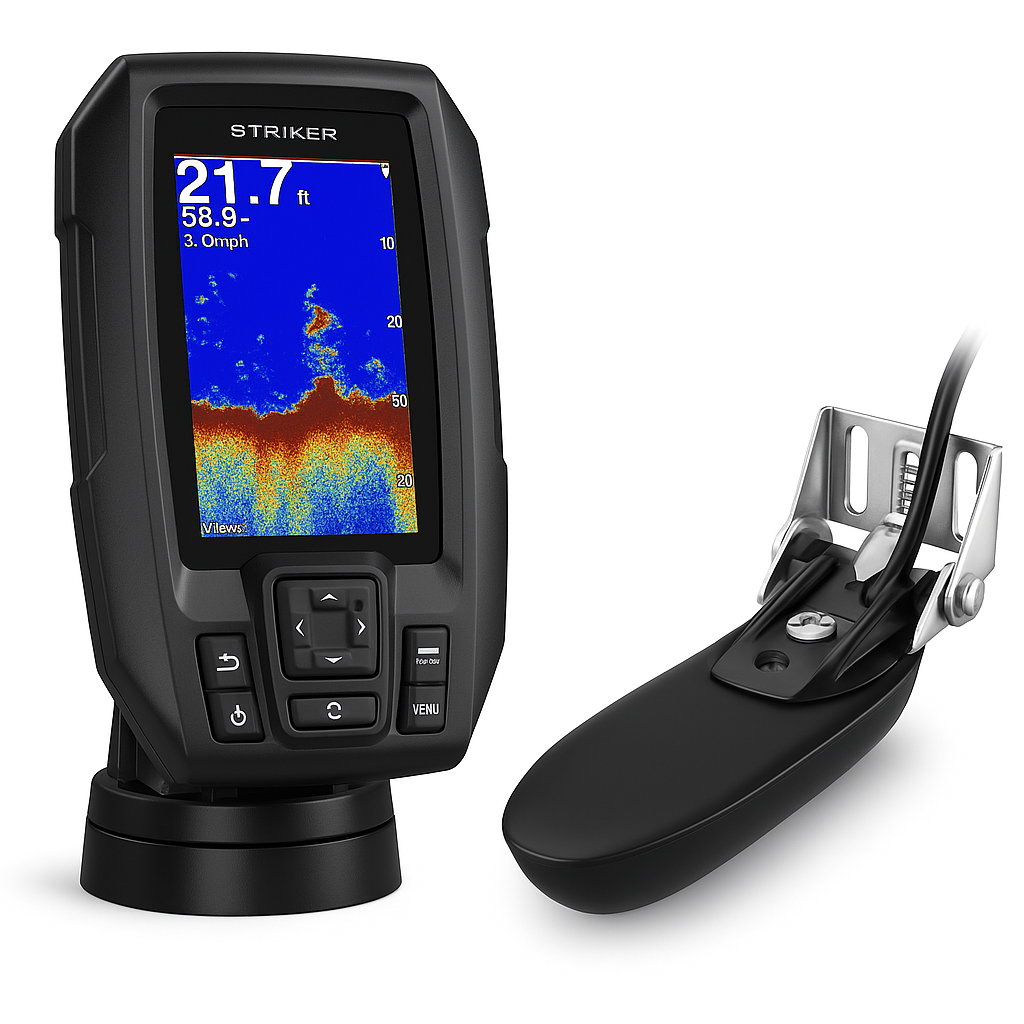
The Garmin 010-01550-00 Striker 4 with Transducer is a 3.5" color GPS fishfinder designed for anglers who want practical sonar performance and basic navigation without the bulk or expense of a full chartplotter.
This standalone unit combines:
- 3.5-inch color display (480 × 320 resolution)
- Built-in high-sensitivity GPS for marking waypoints and tracking speed
- Included CHIRP (77/200 kHz) dual-beam transducer
- A keypad-based interface in a compact, mountable housing【0search0】【0search1】
The Striker 4 sits in Garmin’s entry-level line, aimed at small boat, kayak, and ice anglers who want reliable depth, structure, and fish targets along with simple GPS-based positioning. It does not display full cartographic charts, but its waypoint and track features support basic navigation back to spots, ramps, and docks.
Feature Breakdown
CHIRP Sonar with Included Transducer
The unit ships with a Garmin CHIRP 77/200 kHz transom-mount transducer. CHIRP (Compressed High-Intensity Radiated Pulse) sweeps a range of frequencies instead of transmitting a single frequency, which generally provides:
- Better target separation between closely spaced fish
- Clearer definition of the bottom and structure
- Reduced clutter compared with traditional single-frequency sonar at the same band【0search5】【0search10】
The transducer supports 200 W RMS / 1,600 W peak-to-peak transmit power, typical for compact recreational fishfinders in this class.
Garmin also supports optional transducer upgrades (such as GT8 or GT15 series, sold separately) for users who want improved performance in deeper water or specific applications【0search1】.
Built-In High-Sensitivity GPS
The Striker 4 integrates a high-sensitivity GPS receiver that allows you to:
- Mark and name waypoints for hot spots, structure, docks, and ramps
- Follow your GPS track as you move
- See your speed over ground directly on the fishfinder【0search0】【0search10】
Although it does not support full chart mapping, the combination of waypoints, tracks, and speed readouts is valuable for trolling, repeating drifts, or navigating back to productive locations.
Display and Interface
Key hardware and interface elements include:
- 3.5" color TFT display, 480 × 320 pixels, with a 1.9" × 2.9" active screen area【0search12】
- Brightness adjustable for different light conditions
- Physical keypad controls (directional pad and dedicated keys), which remain usable with wet or gloved hands【0search1】
Despite the small diagonal size, the resolution is sufficient for crisp sonar arches and bottom contour lines when the screen is viewed at typical helm or kayak-mount distances.
Sonar Modes and Functionality
Within Garmin’s STRIKER family feature set (varies slightly by configuration), the Striker 4 offers:
- Traditional CHIRP sonar view for general fish finding
- Adjustable gain, range, and zoom
- Fish symbol options and alarms
- Depth readout and water temperature (when the transducer’s temp sensor is in direct contact with water)
Many anglers also use it in flasher-style displays for vertical jigging or ice fishing, aided by the responsiveness of CHIRP returns【0search13】【0search15】.
Mounting and Power
- Includes a tilt/swivel mount for the head unit
- Standard transom mount hardware for the included transducer
- Operates from a 12 V DC power source, commonly a small sealed lead-acid or lithium battery for portable or kayak setups【0search5】
Optional portable kits (sold separately) add a carrying case, base, and battery compartment, which are especially useful for ice fishing or rental boats【0search7】【0search16】.
Pricing Position
Exact pricing fluctuates between retailers, but the Striker 4 typically occupies the budget to lower mid-range tier for GPS-equipped fishfinders. On the product page at Amazon ($139.99), it frequently competes with similarly sized entry-level units that may lack GPS or CHIRP.
Performance Insights
Sonar Clarity and Target Separation
In practice, the Striker 4’s CHIRP sonar delivers a noticeable improvement in clarity over older, non-CHIRP 2D models at comparable frequencies. Users can expect:
- Clearer representation of fish as distinct arches or symbols
- Better separation between fish and bottom or between stacked fish
- Readable bottom hardness changes (e.g., transitions from mud to rock) that can help identify productive structure【0search5】【0search10】
For typical freshwater depths (lakes, rivers, reservoirs), the 77/200 kHz CHIRP coverage is well-suited, providing both adequate depth capability and a reasonable coverage cone for boat and kayak use.
GPS Reliability and Use Cases
The high-sensitivity GPS generally acquires a fix quickly and maintains lock under open sky. It supports several common use cases:
- Waypoint marking of underwater humps, drop-offs, weedlines, or brush piles
- Tracking trolling passes, allowing you to replicate speeds and lines when you find fish
- Monitoring speed for trolling crankbaits or spinners
Because the Striker 4 does not display full charts, you rely on the simple waypoint and track views for positional context. Many anglers supplement it with a separate phone or handheld GPS app when detailed cartography is needed.
Performance at Speed
Like most compact transom-mounted sonar systems, return quality can degrade at higher boat speeds if the transducer is not optimally positioned. A well-aligned transducer should provide usable bottom readings at moderate cruising or trolling speeds, but very fast runs may show partial or intermittent bottom until speed is reduced. Careful transducer mounting (height and angle) is essential for best results.
Ice and Kayak Fishing
Although it’s sold primarily as an open-water fishfinder, the Striker 4 is widely adopted for:
- Kayaks and small inflatables, where its small footprint and low power draw are advantages
- Ice fishing, when paired with a portable kit and appropriate transducer, thanks to its real-time response and flasher-style display options
In these setups, the compact size and physical buttons are more beneficial than a larger, touch-only screen.
Usability
Setup and Installation
For a fixed-boat installation, setup is straightforward for most DIY users:
- Mount the display using the included tilt/swivel bracket.
- Install the transducer on the transom, following Garmin’s height and angle guidelines.
- Run the power cable to a fused 12 V source.
- Perform basic configuration: language, units, alarms, and transducer type.
Garmin’s documentation and on-screen prompts make the process approachable even for users new to electronics, though drilling into a hull or transom remains a step that some may prefer to leave to a professional.
Interface and Menu System
The Striker 4’s interface is menu-driven via its keypad, with:
- Dedicated keys for common actions
- Directional pad navigation
- Clear labeling of sonar and GPS pages
Once configured, most anglers primarily switch between the main sonar view, flasher (if used), and a minimal GPS page for speed and waypoints. Adjustments like gain, range, and zoom are reasonably intuitive and can be learned in a few outings.
Readability and Form Factor
The 3.5" display is small, which brings notable pros and cons:
Advantages
- Fits easily on crowded dashboards, small consoles, and kayak tracks
- Consumes little power, making it suitable for compact battery setups
- Lightweight, so brackets and mounts do not need to be heavy-duty
Limitations
- Split-screen or multi-pane layouts are constrained; most users will prefer single-view operation
- Viewing multiple data fields simultaneously can feel tight; you may need to prioritize what’s shown
For one- or two-person boats where the operator sits close to the unit, resolution and color contrast are typically adequate.
Trade-offs
Pros
- CHIRP sonar in an affordable, compact package
- Built-in GPS for waypoint marking, tracks, and speed
- Included CHIRP 77/200 kHz transducer, ready to fish out of the box【0search0】【0search5】
- Simple, keypad-based controls that work well in wet or cold conditions
- Small footprint, ideal for kayaks, jon boats, and portable ice-fishing kits
- Compatibility with higher-performance transducers (sold separately) for specialized needs【0search1】
Cons
- No built-in cartography; you get GPS waypoints and tracks but not full charts
- Small 3.5" screen limits multi-view layouts and can be harder to see from a distance
- Return quality at higher speeds depends heavily on transducer mounting quality
- To leverage it for ice fishing or frequent boat transfers, a portable kit and/or alternate transducer adds to total system cost
How It Compares
Compared with similarly priced traditional (non-GPS) fishfinders, the Striker 4’s GPS-based waypoint and speed tracking are major differentiators. Against larger 5" and 7" chartplotter/fishfinder combos, it trades screen size and mapping for cost savings and a more compact form.
For anglers who primarily need basic sonar plus the ability to mark and return to spots, the Striker 4 hits a useful balance between functionality and budget.
Conclusion
The Garmin Striker 4 (010-01550-00) is a focused, entry-level CHIRP fishfinder with integrated GPS that delivers solid performance in a compact, affordable package. Its strengths lie in simple operation, reliable sonar for typical freshwater and inshore depths, and practical GPS capabilities for marking and revisiting productive areas.
It will appeal most to:
- Kayak and small-boat anglers with limited console space
- Budget-conscious users who still want CHIRP and GPS
- Ice anglers building a versatile, portable sonar kit
If you require large-screen charting, advanced imaging like side scan or ClearVü, or complex networked systems, you’ll need to look higher in Garmin’s lineup or at competing multi-function displays. But for many anglers, especially those just getting into sonar or equipping a smaller craft, the Striker 4 offers a well-rounded feature set at an accessible price point, as available on its Amazon product page at $139.99.