
Uniden UM385 Review: A Practical 25W Fixed-Mount Marine VHF for Everyday Boaters
Overview
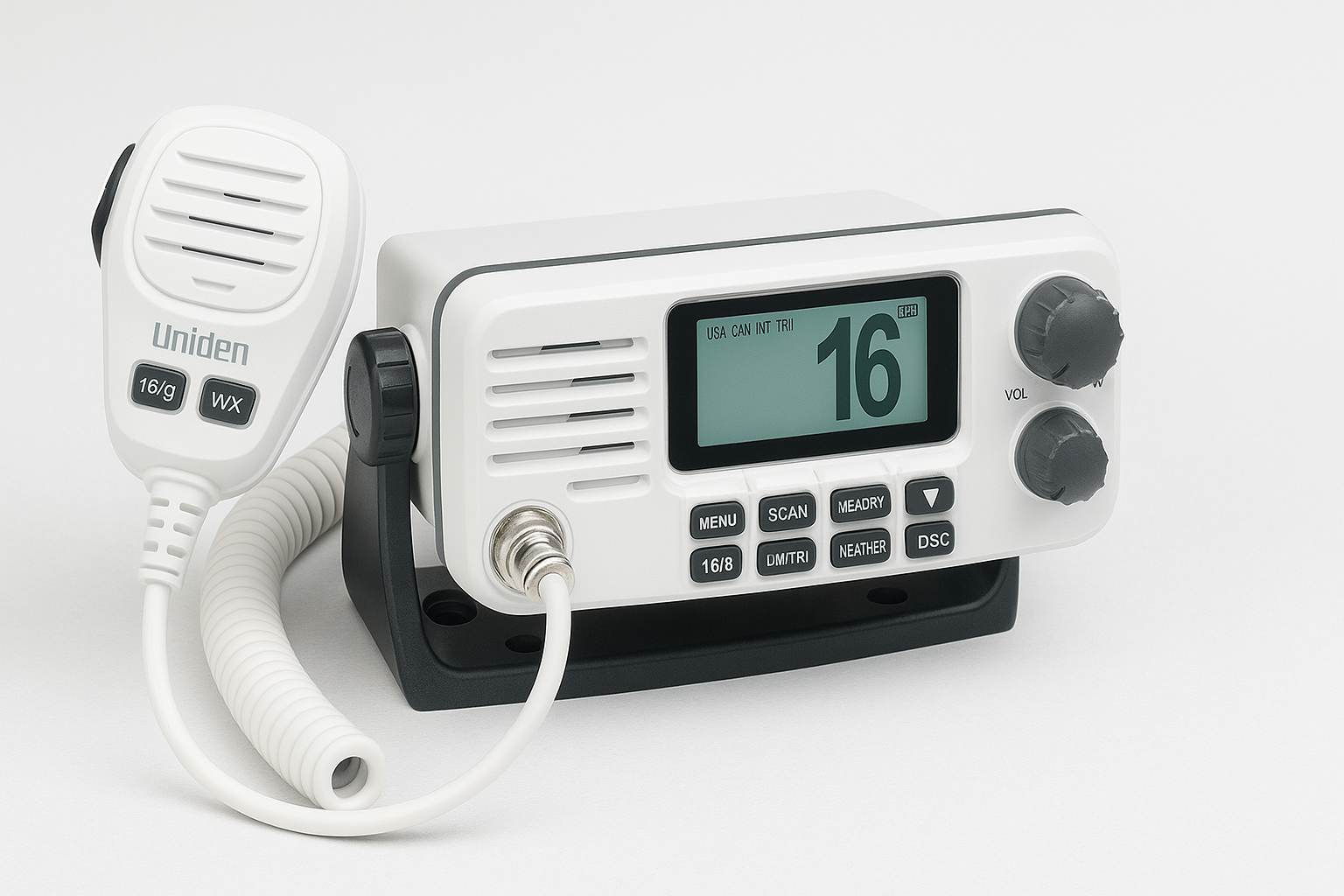
The Uniden UM385 25 Watt Fixed Mount Marine VHF Radio is a Class D DSC (Digital Selective Calling) set designed for small to mid-sized boats that need dependable VHF communications without the price or complexity of high-end units. Available in white (as in this model) and black variants, it focuses on essential safety and communication features: 25 W transmit power, IPX4 waterproofing, NOAA weather alerts, and full coverage of USA, International, and Canadian marine channels.
For skippers upgrading from a basic handheld or older fixed-mount radio, the UM385 offers a straightforward path to modern DSC distress calling and continuous weather monitoring while keeping overall system cost around $107.99 when sourced from the product page.
Key Highlights
- 25 W fixed-mount VHF with selectable low power for close-in communications
- Class D DSC for distress, individual, urgency, and safety calls
- IPX4/JIS4 waterproof rating, suitable for wet helm environments
- Triple Watch and Memory Scan for monitoring multiple channels at once
- Full US/International/Canadian channel set, including 4-digit and Canadian "B" channels
- NOAA/S.A.M.E. weather alerts to warn of severe conditions
- Front-panel design with backlit LCD and keypad for day/night use
- NMEA 0183 input/output for GPS position sharing to enable DSC position reporting
Core Features
25-Watt Transmitter with Hi/Lo Power
The UM385 delivers up to 25 watts of RF output power, the standard maximum for fixed-mount marine VHF, allowing range that typically exceeds handheld sets when paired with a proper antenna installation. A Hi/Lo power switch lets you drop to low power (1 W) for short-range harbor or marina communications, reducing channel congestion and battery draw on smaller electrical systems.
Class D DSC (Digital Selective Calling)
The radio supports Class D DSC, which separates the distress and safety signaling from the voice traffic. Once programmed with your MMSI and connected to a GPS via NMEA 0183, it can:
- Send a one-button distress call including your vessel identity and position
- Make individual DSC calls to other boats
- Handle urgency and safety messages
- Transmit and receive position reports
- Perform DSC test calls and auto-switch to the designated voice channel after a DSC call
This substantially improves your ability to raise help quickly in an emergency, especially if voice communication is difficult.
IPX4 Waterproof Construction
Rated to IPX4/JIS4, the UM385 is protected against splashing water from any direction. It is not intended for full submersion, but it is suitable for typical exposed helm positions where spray, rain, and wet hands are routine. The housing, controls, and display are designed to resist corrosion and moisture for normal coastal and inland use.
Channel Coverage and Scanning
The set includes all standard marine VHF channels for:
- United States
- International waters
- Canada, including Canadian “B” channels and 4-digit channels
Channel 16 remains a dedicated distress and calling channel, and the radio offers a 16/9 priority key for instant access to emergency and secondary calling channels.
Scanning capability includes:
- Memory Channel Scan – scans only saved favorite channels
- Triple Watch – monitors channel 16 and two additional channels
This allows you to keep an ear on a working channel, the local harbor/marina channel, and 16 simultaneously.
NOAA Weather and S.A.M.E. Alerts
The UM385 integrates NOAA weather channels and S.A.M.E. (Specific Area Message Encoding) weather alert functionality. Once configured, it can:
- Receive continuous NOAA weather broadcasts
- Trigger an audio/visual alert when severe weather or emergency bulletins are issued for your programmed area
For coastal cruisers, anglers, and lake boaters, this can provide valuable lead time to head for shelter before conditions deteriorate.
Display and Controls
The front-panel layout centers on a backlit LCD with adjustable brightness and a bank of clearly labeled buttons for menu, scanning, memory, weather, and DSC functions. A large rotary knob handles volume and power, while a separate control manages squelch.
Key elements:
- Backlit keypad and display for night operations
- Dedicated buttons for Channel 16/9, menu, memory, and scan
- Channel naming support, allowing you to label frequently used channels for easier recall
Connectivity and Mounting
The radio includes NMEA 0183 input/output, so you can connect it to a GPS receiver or chartplotter to automatically populate position data for DSC messages. This is strongly recommended to get full benefit from DSC distress and position-report features.
The UM385 is supplied with a standard mounting bracket for surface installation. Optional accessories such as a flush-mount kit are available if you prefer an integrated helm appearance.
Usage Experience
Installation
Installing the UM385 is typical of fixed-mount VHF radios:
- Connect to 12 V DC power with a properly fused supply
- Route and connect the external VHF antenna via standard SO-239 connector
- Optionally integrate with a GPS using NMEA 0183 wiring
- Mount the radio using the included bracket or an optional flush-mount kit
Owners familiar with basic marine wiring generally find the process straightforward. New installers should budget time to route NMEA and antenna cables neatly and ensure a solid, low-loss antenna installation, as antenna height and quality heavily influence real-world range.
On-Water Operation
Once programmed with an MMSI and basic preferences, the UM385 is easy to live with:
- Audio output is loud enough for open cockpits on small and mid-sized boats
- Controls are intuitive, with direct access to key functions (weather, scan, 16/9)
- Triple Watch is particularly useful when monitoring a working channel and channel 16 while still being reachable on a second channel
- Weather alerts are noticeable but not excessively intrusive when configured appropriately
Users moving up from a handheld typically report a clear improvement in range and clarity, especially when using a well-sited fixed antenna at masthead or radar-arch height.
Strengths
- Comprehensive safety features for this class: Class D DSC, weather and S.A.M.E. alerts, Triple Watch
- Full 25 W transmit power with low-power option for harbor work
- Broad channel coverage (US/International/Canadian, including 4-digit and "B" channels)
- Straightforward user interface, suitable for occasional and experienced operators alike
- IPX4 splashproof design appropriate for most helm locations
- NMEA 0183 connectivity to GPS, unlocking automatic position in distress calls
- Generally budget-friendly, with typical street prices around $107.99 depending on retailer and promotions
Weaknesses
- IPX4 rating is splashproof, not submersible; not ideal for very exposed, wet locations where gear may be drenched or briefly submerged
- No built-in GPS – requires external GPS and wiring to fully utilize DSC position reporting
- Lacks AIS receiver and advanced networking (NMEA 2000) found on higher-end models
- No support for remote handheld/microphone stations, limiting control to the main unit
- Audio and display are functional rather than premium – adequate for most, but not as refined as top-tier sets
Suitable Scenarios
The Uniden UM385 is best suited to:
- Trailerable fishing boats and center consoles needing a reliable primary VHF without advanced networking
- Small sailboats and cruising boats that want DSC distress capability and continuous weather monitoring on a budget
- Inland and coastal recreational boats operating primarily within VHF range of shore stations
- Owners upgrading from a handheld VHF who want stronger transmit power and fixed wiring to ship’s power
It is less suitable for:
- Offshore passagemakers who may prefer AIS integration, built-in GPS, and NMEA 2000 networking
- Installations exposed to frequent green water or full dunking, where higher waterproof ratings (IPX7 or better) are advisable
- Multi-station yachts that need remote microphones, intercom functionality, or integrated audio systems
Final Evaluation
The Uniden UM385 delivers a well-rounded feature set for an entry- to mid-level fixed-mount marine VHF radio. Its combination of 25 W transmit power, Class D DSC, NOAA/S.A.M.E. weather alerts, Triple Watch, and broad channel support addresses the safety and communication needs of most recreational boaters.
While it lacks extras like built-in GPS, AIS, or NMEA 2000, its capabilities align well with its price bracket around $107.99, making it a sensible choice for skippers who prioritize core reliability and essential safety features over advanced integration. If you’re outfitting a small to mid-sized boat and want a dependable, straightforward VHF with modern DSC functionality, the UM385 in white is a strong candidate to consider.