
SonicWall Advanced Protection Service Suite for TZ270 (2-Year License) Review
Introduction
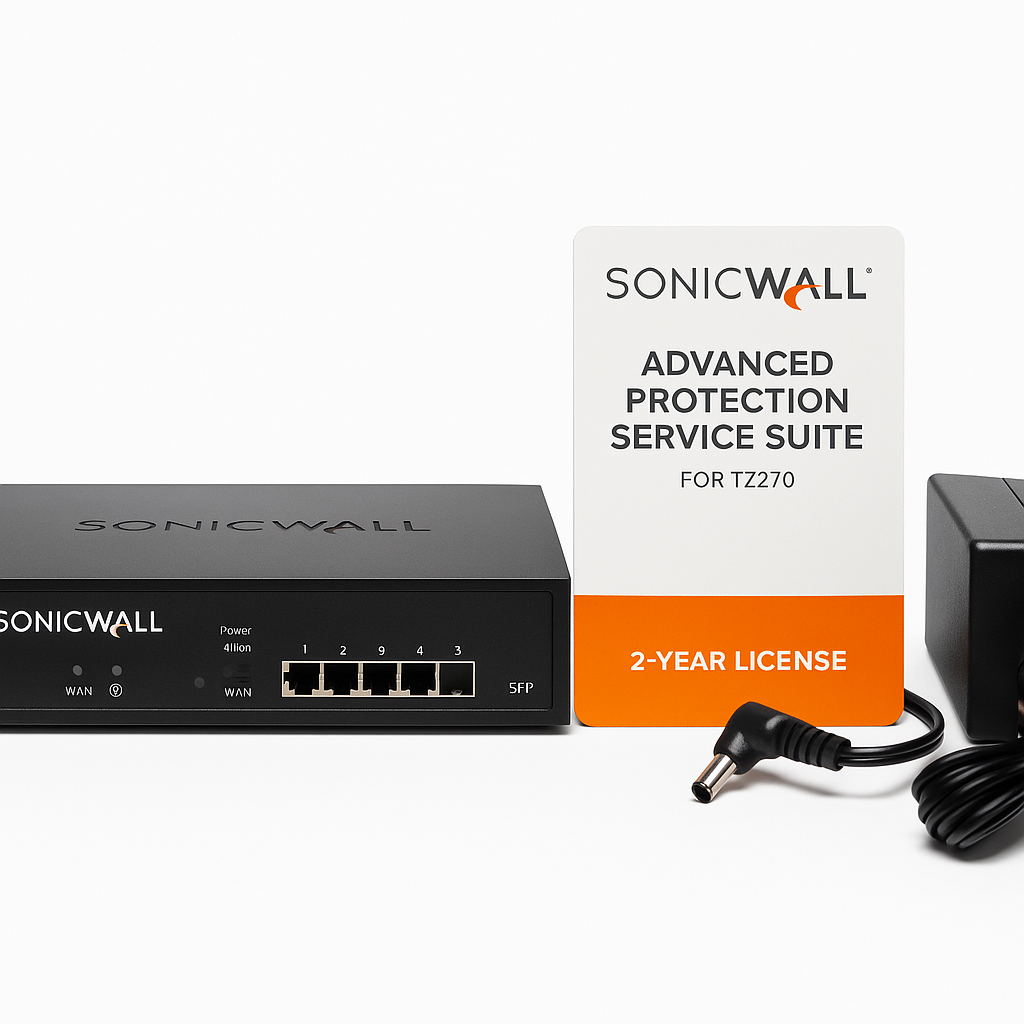
The SonicWall Advanced Protection Service Suite for TZ270 (2-Year License, 02-SSC-6650) is a software subscription that unlocks the full security feature set of a SonicWall TZ270 firewall. Rather than adding new hardware, this license activates a bundle of services designed to protect small and mid-sized networks against both known and zero-day threats.
The Advanced Protection Service Suite (often abbreviated APSS) for TZ270 typically includes:
- Gateway Anti-Virus, Anti-Spyware, and Intrusion Prevention
- Application Control / Application Firewall
- Content Filtering Service (CFS)
- Anti-Spam service
- DNS Security
- Capture ATP (multi-engine cloud sandboxing) with RTDMI technology
- Network visibility tools
- NSM (cloud) management and basic cloud reporting (often 7 days)
- 24x7 hardware and firmware support for the license term
This specific product is a two-year subscription tied to one TZ270 appliance. It is suitable for organizations that want a single bundled license rather than mixing individual security add-ons.
In many online stores and marketplaces, the 2‑year APSS license for the TZ270 is typically listed around $821.59, depending on region and channel, making it a mid‑to‑upper tier option compared to SonicWall’s Threat or Essential Protection suites.
Typical Use Cases
1. Small Business Perimeter Firewall
In a typical small business with 10–50 users, the TZ270 often sits at the network edge, combining routing, VPN, and security in one device. The Advanced Protection Service Suite is used to:
- Inspect all inbound and outbound traffic with deep packet inspection and IPS
- Block malware and command‑and‑control traffic using gateway AV and DNS Security
- Enforce acceptable use policies via URL/content filtering
- Provide secure remote access over site‑to‑site or SSL VPN with threat inspection
2. Branch Office / Remote Site Protection
For organizations with multiple locations, a TZ270 with APSS is a common choice for branch offices. Typical goals include:
- Standardizing security policies across sites via SonicWall NSM cloud management
- Enforcing the same web filtering, IPS, and anti‑malware stack as the main office
- Using Capture ATP to analyze suspicious files coming from remote or less‑managed endpoints
3. Education, Non‑profit, and Public Sector Deployments
Schools and small public sector offices often need content filtering and reporting alongside basic firewalling. The APSS license enables:
- Category‑based content filtering (e.g., adult content, gambling, social media)
- Basic cloud‑based reporting on web usage and threats (short‑term retention)
- Protection aligned with compliance or acceptable‑use requirements
4. Managed Service Provider (MSP)–Managed Firewalls
MSPs frequently deploy TZ‑series firewalls and manage them as a service. APSS on the TZ270 is useful when an MSP wants:
- A defined, comprehensive security bundle they can standardize into a service tier
- Centralized cloud management and visibility through NSM
- 24x7 vendor support to backstop their own SLA
5. Security Hardened Remote Worker / SOHO Offices
For high‑risk remote users (e.g., executives, finance, or developers accessing sensitive environments), placing a TZ270 with APSS in the home or small office can provide:
- Enterprise‑grade threat protection for home broadband connections
- Segmented networks (work vs. personal) with managed policies
- Encrypted VPN tunnels back to corporate infrastructure, scanned by the same security stack
Performance in Each Scenario
Small Business Perimeter Firewall
Security depth: With gateway AV, IPS, application control, and Capture ATP, the suite provides layered protection. Traffic is examined for signatures, behavioral anomalies, and suspicious files are detoured to the cloud sandbox.
User experience: When sized properly (TZ270 is positioned for small environments), the APSS stack generally maintains acceptable throughput for typical office workloads like web browsing, SaaS apps, and email. Enabling every inspection feature plus TLS inspection on very fast connections can introduce latency, so tuning may be required.
Policy control: Application control and CFS allow fine‑grained rules—blocking specific apps, throttling streaming, or restricting categories of sites. For many offices, this enables both productivity and risk management without deploying additional proxy appliances.
Branch Office / Remote Site Protection
Consistency across sites: With NSM cloud management, policies for IDS/IPS, CFS, and app control can be created centrally and applied to multiple TZ270 units. This is particularly useful when the same APSS license model is used across branches.
Visibility: Cloud‑based reporting (typically 7‑day basic reporting in this tier) surfaces threats, top talkers, and web usage trends. For small branches, this is often enough to validate that policies are working and to troubleshoot user issues.
Resilience: 24x7 support and firmware updates improve uptime. In case of failures or critical vulnerabilities, SonicWall support can be engaged without additional contracts during the subscription term.
Education / Public Sector
Content filtering effectiveness: CFS provides category‑based blocking, which can be tuned per group or schedule. For schools, it can block inappropriate categories while leaving educational sites open. The effectiveness largely depends on maintaining up‑to‑date category databases, which is included in the subscription.
Reporting: While the included cloud reporting is basic and short‑retention, it offers enough insight for smaller institutions to verify compliance and detect misuse, though larger districts may prefer a separate SIEM or extended reporting solution.
Threat protection: Capture ATP and DNS Security help protect against phishing‑related malware, drive‑by downloads, and other threats common in loosely managed endpoints, which are typical in educational environments.
MSP‑Managed Firewalls
Operational efficiency: APSS bundles most needed services under one SKU, simplifying quoting, renewals, and lifecycle management. For MSPs, this can reduce administrative overhead.
Remote management: NSM cloud management supports multi‑tenant views and role‑based access, making it easier to manage multiple customer firewalls from one console.
Support alignment: 24x7 support and firmware updates offer a defined escalation path from MSP to vendor, which is helpful when building SLAs with customers.
Remote Worker / SOHO
Security posture: For high‑risk users, having the APSS stack (including Capture ATP and DNS Security) on the home gateway significantly improves defenses compared to a consumer router.
Complexity: The flip side is complexity. Fully leveraging APSS features requires firewall and SonicOS familiarity, which is typically handled by corporate IT or an MSP, not the end‑user.
Strengths Across Scenarios
-
Comprehensive, layered security
APSS for TZ270 delivers multiple security engines in one license: signature‑based AV/IPS, behavioral analysis, URL filtering, anti‑spam, DNS security, and cloud sandboxing. This layered approach improves detection of both commodity and targeted threats. -
Cloud‑based sandboxing (Capture ATP)
Capture ATP with RTDMI technology analyzes suspicious files in a cloud sandbox, aiming to catch zero‑day and polymorphic malware that may bypass traditional signature‑based tools. -
Integrated policy and content control
Application control and CFS provide both security and productivity management. Administrators can restrict bandwidth‑heavy or risky apps, enforce compliance, and apply per‑group or per‑schedule policies. -
Centralized management and visibility (NSM)
NSM cloud management simplifies operations across multiple TZ270 units. Single‑pane‑of‑glass configuration, backups, and basic reporting are particularly beneficial for distributed organizations and MSPs. -
24x7 support and firmware updates included
The bundle includes around‑the‑clock support and ongoing firmware updates for the term of the license, which is important for patching security vulnerabilities and resolving issues without separate contracts. -
Predictable, bundle‑based licensing
Buying a single 2‑year APSS license per firewall simplifies budgeting and renewal cycles compared to assembling individual subscriptions for each feature.
Limitations Across Scenarios
-
Ongoing subscription cost
APSS is positioned as a higher‑tier bundle, and its multi‑year pricing (e.g., around $821.59 for 2 years on many retail platforms) can be significant relative to the underlying hardware, especially for very small organizations. -
Vendor lock‑in to the SonicWall ecosystem
The license only applies to the TZ270 and cannot be transferred to non‑SonicWall platforms. Migrating away from SonicWall typically means writing off remaining license value and re‑architecting policies in a different system. -
Appliance capacity constraints
While the TZ270 is suitable for small environments, enabling all security services (especially deep inspection of encrypted traffic) on very high‑bandwidth links may strain the hardware. Proper sizing and realistic performance expectations are essential. -
Limited built‑in reporting horizon
The included cloud reporting is often limited to basic dashboards and short retention (e.g., 7 days). Organizations with strict auditing or compliance needs may require external logging or higher‑tier reporting options. -
Complexity for non‑specialists
Fully utilizing APSS capabilities—especially application control, granular CFS, and custom IPS rules—requires security and firewall expertise. Smaller organizations without dedicated IT staff may depend heavily on partners or MSPs. -
Model‑specific SKU
The 02‑SSC‑6650 license is specific to the non‑wireless TZ270. Wireless variants (such as TZ270W) require different SKUs. This is important when ordering, renewing, or planning inventory.
Verdict
The SonicWall Advanced Protection Service Suite for TZ270 (2‑Year License, 02‑SSC‑6650) is a robust, feature‑rich subscription for organizations standardizing on SonicWall’s Gen 7 TZ platform. It effectively transforms the TZ270 from a basic firewall into a unified threat management gateway with advanced sandboxing, DNS security, content filtering, and centralized cloud management.
It is best suited for:
- Small and mid‑sized businesses that want a single, comprehensive security bundle on their TZ270
- Branch offices that need consistent policies and centralized oversight
- Schools, non‑profits, and smaller public sector sites that require content filtering plus advanced threat protection
- MSPs building managed firewall offerings around SonicWall appliances
On the other hand, organizations with very tight budgets, extremely high bandwidth requirements, or limited in‑house/network‑security expertise should weigh the recurring license cost and operational complexity against alternatives. SonicWall’s lower‑tier bundles or other vendors may be more appropriate in some cases.
For networks already invested in SonicWall hardware and management tools, the TZ270 Advanced Protection Service Suite offers a balanced combination of security depth, manageability, and vendor support over a multi‑year horizon, with pricing that, while not minimal, is predictable when planned around a two‑year cycle such as $821.59 on platforms like Amazon.
For more details or to purchase the license, you can refer directly to the product page:
- SonicWall Advanced Protection Service Suite for TZ270‑2 Year License (02‑SSC‑6650): https://www.amazon.com/dp/B0FBYMJZGW