
Allen-Bradley 1761-L16BWA MicroLogix 1000 Controller (New, One-Year Warranty) – In-Depth Review
Overview
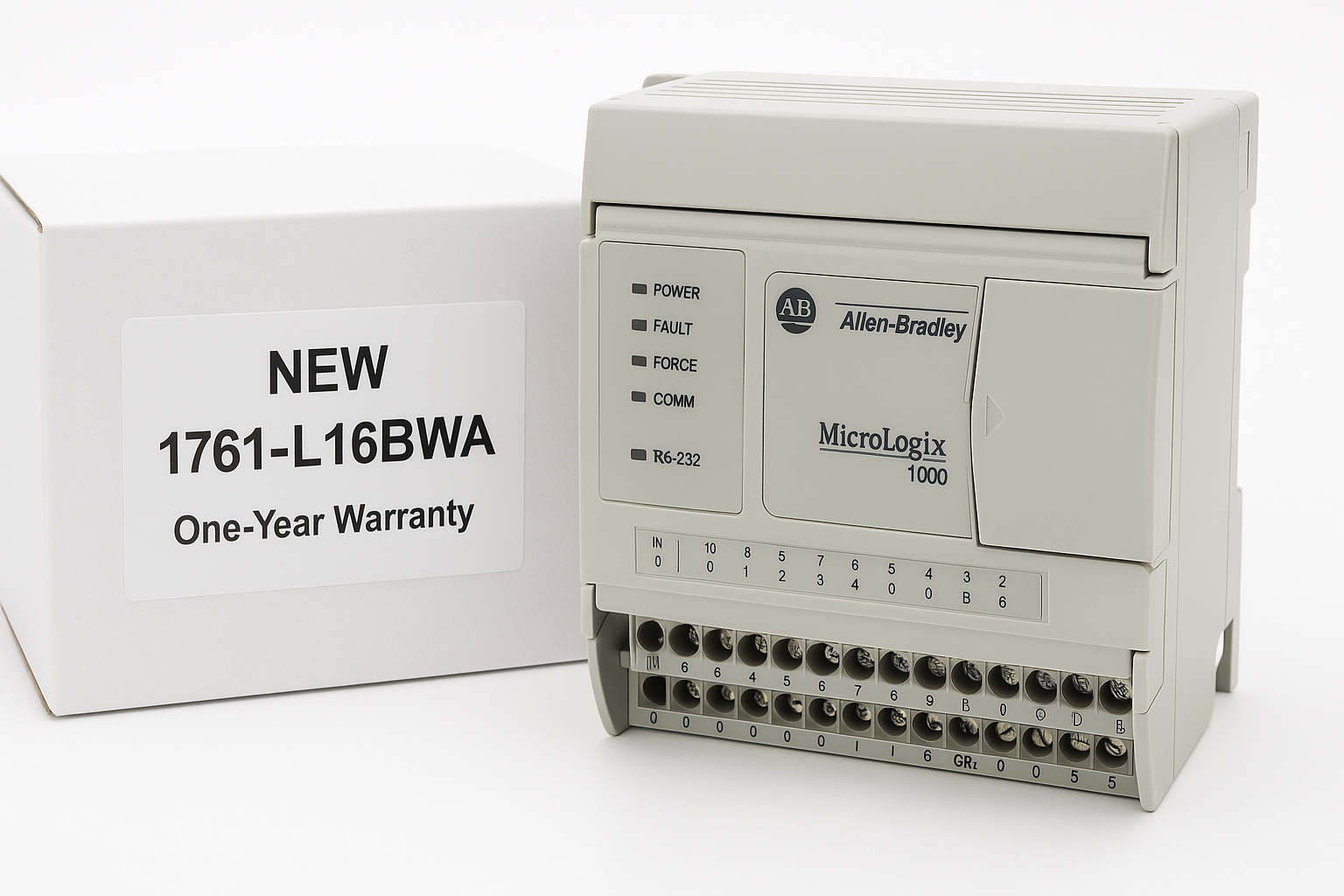
The Allen-Bradley 1761-L16BWA MicroLogix 1000 is a compact PLC designed for straightforward discrete control tasks. It combines a built‑in power supply, 24 V DC digital inputs, and relay outputs in a small enclosure that fits easily into tight control panels. While this series has been officially discontinued by Rockwell Automation, the 1761-L16BWA remains a common choice for maintenance engineers who must keep legacy equipment running without re‑engineering existing hardware and ladder logic.
This specific listing, described as “New 1761-L16BWA 1761-L16BWA One-Year Warranty”, targets users who need a plug‑and‑play replacement module and value the additional assurance of a warranty on a product that is no longer produced by the OEM. The cost of acquiring a unit like this typically falls around $494.00, which is often significantly lower than the combined expense of redesigning a control system around a modern platform.
Key Highlights
- 16 integrated I/O points: 10 x 24 V DC digital inputs and 6 relay outputs.
- Integrated AC power supply: Operates from 120/240 V AC, eliminating the need for a separate PLC power module.
- Compact footprint: Suited for small panels and machine‑level control.
- Legacy continuity: Drop‑in replacement for existing MicroLogix 1000 installations using the 1761-L16BWA catalog number.
- One-year warranty: Helpful risk mitigation when purchasing a discontinued automation component.
- Suitable for simple to moderately complex logic: With 1 K EEPROM memory and basic communication capabilities.
Core Features
I/O Configuration
- Digital Inputs: 10 inputs rated for 24 V DC, ideal for proximity switches, photoelectric sensors, and pushbuttons.
- Relay Outputs: 6 relay outputs capable of switching AC or DC loads, offering flexibility for controlling contactors, solenoids, and indicator lights.
- Total I/O: 16 points, which is appropriate for compact machines or single‑station processes.
Power and Electrical Characteristics
- Power Supply: 120/240 V AC input, so it can be powered directly from standard industrial mains without an additional DC power supply.
- Isolation and Protection: Designed to withstand typical industrial electrical environments, with isolation between field and logic circuits (per standard MicroLogix 1000 specifications).
Processing and Memory
- Controller Class: MicroLogix 1000 family, aimed at entry‑level PLC applications.
- Memory: 1 K EEPROM, sufficient for a few hundred instructions and associated data, covering many small automation projects.
- Non‑volatile storage: Logic is retained in EEPROM, protecting programs during power loss.
Communication and Integration
- Serial Port: RS‑232 port supporting DF1 protocol for programming, monitoring, and basic data exchange.
- Programming Environment: Compatible with legacy Allen‑Bradley programming tools designed for MicroLogix 1000, allowing reuse of existing project files.
Physical Design
- Compact enclosure: Intended for DIN‑rail or panel mounting in crowded cabinets.
- Front‑accessible terminals: Screw terminals for straightforward wiring and maintenance.
Warranty and Condition
- The product listing emphasizes "New" condition with a one‑year warranty, important for users concerned about the reliability of surplus or previously used components.
- The warranty helps offset risk when investing in a discontinued part, especially when the PLC is mission‑critical.
Usage Experience
In practical use, the 1761-L16BWA is best regarded as a reliable workhorse for small, deterministic tasks. Typical deployment scenarios include:
- Stand‑alone machine control (e.g., conveyors, indexing tables, simple packaging lines).
- Small process skids or auxiliary equipment where only a modest number of I/O points are required.
- Legacy equipment where the existing control logic is stable and there is no immediate justification for a major controls upgrade.
Engineers familiar with Rockwell Automation’s ecosystem will find the programming workflow straightforward, particularly if they are already maintaining other MicroLogix or SLC systems. Existing ladder logic routines can usually be transferred directly when replacing a failed unit, minimizing downtime.
The limited memory and communication options make it less suited to modern data‑intensive or network‑centric architectures. For example, integrating with plant‑wide Ethernet networks, SCADA, or IIoT systems often requires protocol converters or additional hardware.
However, where requirements are modest—discrete I/O, simple sequence control, and minimal data logging—the 1761-L16BWA still provides consistent, predictable operation. For maintenance teams, being able to swap a failed processor with a pin‑compatible replacement and restore production quickly is often more valuable than introducing new technology.
Strengths
- Drop‑in compatibility for existing MicroLogix 1000 installations using the 1761-L16BWA part number.
- Integrated 120/240 V AC power supply, reducing hardware count and wiring complexity.
- Flexible relay outputs capable of switching both AC and DC loads, simplifying actuator selection.
- Compact size suitable for small enclosures and machine‑mounted panels.
- Robust and proven hardware platform, with a long track record in industrial environments.
- Non‑volatile EEPROM memory provides resilience to power interruptions.
- One-year warranty offers additional confidence when buying a discontinued product.
Weaknesses
- Discontinued by the OEM: As a legacy product, long‑term availability of new units cannot be guaranteed.
- Limited memory and feature set compared with current‑generation PLCs, restricting program complexity and data handling.
- Serial‑only communications: Lacks native Ethernet or modern fieldbus interfaces, increasing integration effort for networked systems.
- Not ideal for new designs where lifecycle support, cybersecurity, and advanced diagnostics are priorities.
- Potential variability in supply chain (surplus or third‑party sellers) requires careful vendor selection and verification of authenticity.
Suitable Scenarios
The New 1761-L16BWA with a one‑year warranty is best suited for:
-
Maintenance and MRO (Maintenance, Repair, and Operations)
- Plants with a large installed base of MicroLogix 1000 controllers that must be kept operational.
- Spare‑parts stocking to minimize downtime risk for critical legacy machines.
-
Like‑for‑like replacement on legacy equipment
- When a 1761-L16BWA fails and the fastest, lowest‑risk solution is to replace it with an identical model.
- Situations where re‑writing and re‑validating control logic on a new platform would be too time‑consuming or costly.
-
Cost‑conscious upgrades within an existing design
- Adding or replacing a controller in a standard machine design that has been deployed across multiple sites.
- Operators who need predictable behavior and prefer not to introduce a different PLC family.
Scenarios where this product is less suitable include:
- Brand‑new projects that require long‑term vendor support and alignment with current product roadmaps.
- Applications demanding extensive communication options (e.g., Ethernet/IP, Modbus TCP, OPC UA) or high‑level data integration.
- Systems where functional safety certifications, modern security features, or large program sizes are important.
Final Evaluation
The Allen-Bradley 1761-L16BWA MicroLogix 1000 remains a practical and effective solution for supporting legacy automation systems. Its combination of integrated AC power, 24 V DC inputs, and relay outputs in a compact enclosure matches the needs of many small machines and auxiliary systems. While its technical capabilities are modest compared with contemporary PLC platforms, they are more than adequate for the discrete, well‑understood tasks for which this controller was originally deployed.
For organizations that rely on existing 1761-L16BWA units and need to minimize downtime and engineering change, purchasing a new replacement with a one‑year warranty is a rational and often cost‑effective choice. The use of a unit like this, priced around $494.00, allows maintenance teams to keep equipment running as‑is, deferring or avoiding the expense of a full control system redesign.
Conversely, for new machine designs or large modernization projects, it is generally more prudent to adopt a current‑generation PLC family that offers broader communication capabilities, better tooling, and a clear long‑term support path. In summary, this product excels as a reliable, warranty‑backed spare for legacy MicroLogix 1000 installations, rather than as the foundation for new automation architectures.