
Midland WR120B NOAA Emergency Weather Alert Radio Review
Quick Summary
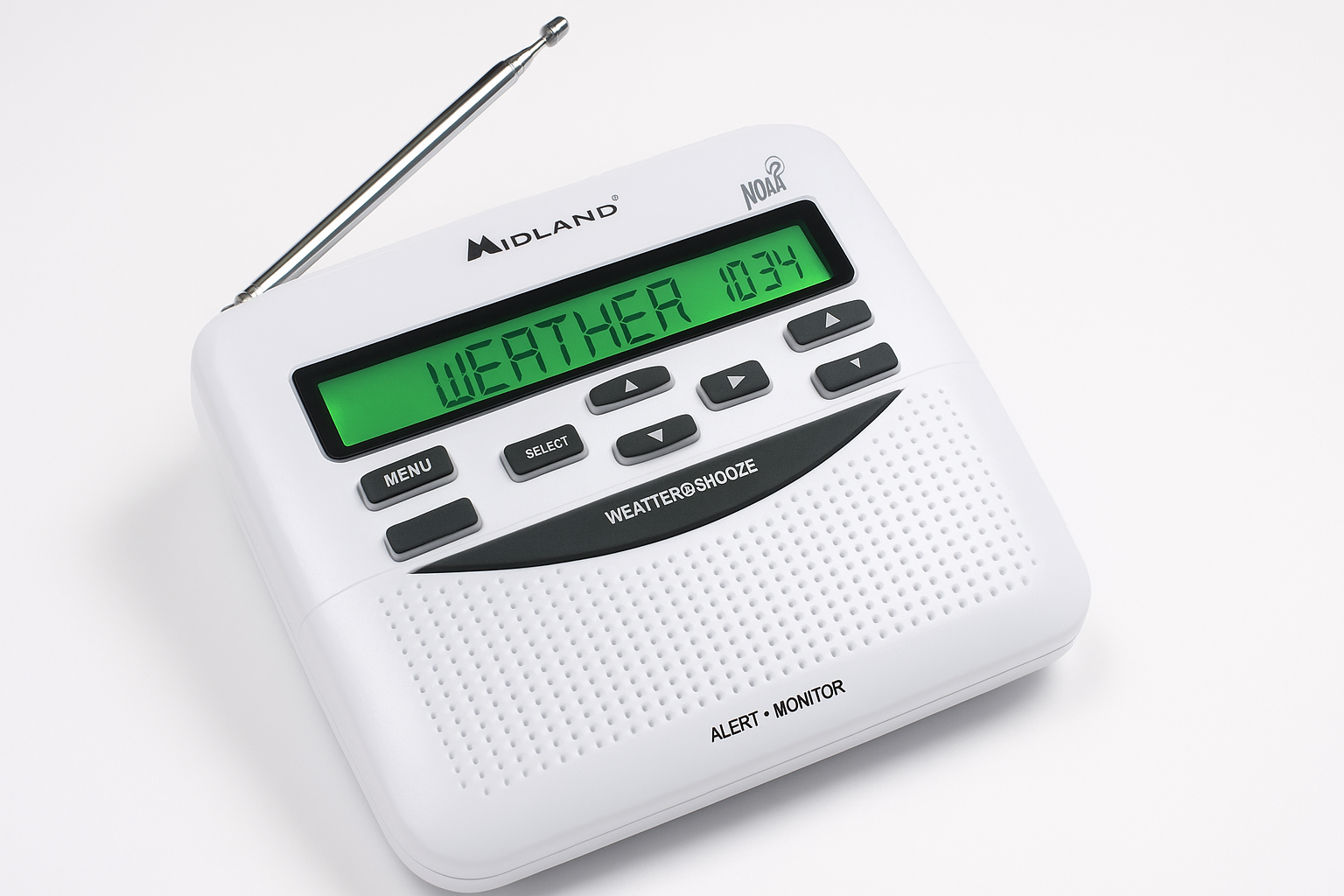
The Midland WR120B NOAA Emergency Weather Alert Radio is a purpose-built desktop radio that automatically monitors NOAA weather channels and activates when severe weather or other emergency alerts are issued for your area. It uses SAME (Specific Area Message Encoding) so you can restrict alerts to specific counties, reducing false alarms. With a clear LCD, color-coded alert indicators, a built-in alarm clock, and battery backup, the WR120B is designed as a plug‑in, always‑ready warning device rather than an everyday entertainment radio.
If you are looking for an affordable, straightforward way to receive official National Weather Service alerts at home or in a small office, the WR120B remains one of the most popular and proven options in its category. On retailers like Amazon, it is typically found around $49.99, which places it in the accessible, entry-level price range for a dedicated NOAA weather radio.
Detailed Analysis
Design and Build Quality
The Midland WR120B has a compact, low-profile desktop design. It is meant to sit in a fixed location—on a nightstand, kitchen counter, or office desk—where it can stay plugged in and ready.
Key design elements:
- Footprint and layout: The unit is roughly the size of a small alarm clock, with a front-facing speaker and a backlit LCD display on top. The screen shows time, alert type, and basic status indicators.
- Button layout: Dedicated buttons for MENU, SELECT, UP/DOWN arrows, WEATHER/SNOOZE, ALERT ON/OFF, and VOLUME are placed on the top/front area, making configuration and manual listening fairly intuitive.
- Indicators and LEDs: Color-coded LEDs (typically green, yellow, orange, red) correspond to power status and alert severity levels (advisory, watch, warning), providing at-a-glance information.
- Connectivity: On the back, you’ll find the DC power jack, external antenna jack, external alert jack, and a headphone output, giving flexibility for improved reception or accessibility add-ons (like strobe lights or bed shakers).
The plastic housing feels basic but appropriate for an indoor device in this price class. It is not ruggedized or water-resistant, so it’s meant for indoor stationary use rather than field or camping scenarios.
Power and Backup
The WR120B is designed to run primarily on AC power via the included adapter. For outages, it supports a battery backup using three AA alkaline batteries. The batteries preserve time, programming, and alert functionality during power failures—critical for overnight storms or grid disruptions.
This dual-power arrangement makes it a strong fit for emergency preparedness: as long as NOAA transmitters are active and you have battery power, alerts should continue even when mains power is down.
NOAA and SAME Functionality
The core appeal of the WR120B is its NOAA Weather Radio and SAME capabilities:
- 7 NOAA weather channels: You can tune to the local NOAA transmitter with the best reception, so the radio continuously monitors that broadcast in standby mode.
- SAME location programming: You can program a single county, multiple counties (up to 25), or any location. This allows you to:
- Limit alerts to your specific county to reduce noise from distant storms.
- Add surrounding counties if you want earlier heads-up on inbound weather.
- Alert filtering: The radio can recognize over 60 (often more than 80, depending on firmware/region) different alert codes, including tornado warnings, severe thunderstorm warnings, flash flood warnings, AMBER alerts, and various civil emergency messages.
Selectable alert types typically include:
- TONE: Loud siren only.
- VOICE: Siren followed by the NOAA voice broadcast.
- DISPLAY: Visual/text alert only, with no loud tone (useful in quieter environments where you don’t want alarms at night for minor events).
This flexibility is essential if you want to tailor how intrusive alerts are, while still ensuring that the most critical warnings (e.g., tornado warnings) will wake you.
Interface, Display, and Languages
The WR120B includes a trilingual display, supporting English, Spanish, and French. During setup you can select your preferred language for menu navigation and text alerts.
The LCD display provides:
- Current time (12- or 24-hour format).
- Alert type and description when triggered.
- Basic status icons (such as NOAA reception and alert indicators).
Menu navigation is primarily via the MENU, SELECT, and UP/DOWN buttons. While the interface is more utilitarian than polished, it’s straightforward after the initial learning curve. Initial configuration typically involves:
- Setting language.
- Setting time.
- Choosing location mode and entering SAME codes.
- Selecting NOAA channel with the strongest signal.
- Choosing alert type and optional event filters.
Alarm Clock and Everyday Use
Beyond emergency features, the WR120B includes a simple alarm clock with snooze. This allows the device to double as a bedside clock, which helps justify its permanent spot in a bedroom or living area.
The WEATHER/SNOOZE button serves dual purposes:
- Tapping it during normal operation can activate the live NOAA broadcast so you can listen to forecasts on demand.
- When the alarm goes off, pressing it will snooze the alarm for a short period.
Though the clock and alarm are basic, they are perfectly serviceable for everyday use and encourage users to keep the radio plugged in and visible.
Alert Performance and Reliability
In real-world use, the value of a weather radio is defined by whether it triggers reliably and promptly when alerts are issued for your area:
- When the National Weather Service issues a compatible SAME alert that includes your programmed county, the WR120B sounds the chosen alarm type and lights the appropriate LED.
- Alerts remain on-screen long enough to be noticed, and you can silence the siren by pressing a button while keeping the visual information available.
- With a solid NOAA broadcast signal and correctly configured SAME codes, the WR120B is generally regarded as responsive and trustworthy for severe weather notifications.
Users in fringe reception areas may need to experiment with radio placement or use the external antenna jack to ensure consistent signal quality. Reception quality is highly location-dependent, so some trial and error may be necessary.
User Experience
Setup and Learning Curve
Initial setup involves more steps than a typical clock radio, but that’s expected for a SAME-capable weather radio. The process usually looks like this:
- Power up the radio and install backup batteries.
- Walk through the on-screen prompts for language, time, location, and channel.
- Look up your local SAME county codes (often via NOAA or local emergency management websites) and program them in.
- Set your alert mode (tone, voice, display) and whether to filter certain event types.
Once configured, day-to-day interaction is minimal. Most of the time, the WR120B quietly monitors the weather channels in standby. Users primarily interact with it when:
- An alert is triggered and they silence the tone.
- They tap the WEATHER button to hear the latest forecast.
- They adjust time, alarms, or event filters.
For many users, the initial configuration is the only slightly technical step; afterward, the radio behaves as an appliance.
Everyday Practicality
In practice, the WR120B lends itself well to:
- Bedrooms and nurseries, where severe weather can occur overnight and a loud tone is needed to wake occupants.
- Kitchens and living rooms, where the family gathers and can see/hear alerts.
- Small offices or classrooms, where reliable, official alerts can supplement local sirens and phone alerts.
Because the device lacks AM/FM entertainment features and streaming capabilities, there’s very little to distract from its primary role: alerting. For users who want a simple, dedicated safety tool rather than an all-in-one radio, this is a positive.
Pros
- Dedicated emergency focus: Purpose-built NOAA/SAME radio designed for early warning and safety, not general entertainment.
- SAME location targeting: Ability to program single or multiple counties helps avoid unnecessary alarms from distant areas.
- Multiple alert modes (tone, voice, display) and adjustable alert volume on newer revisions provide flexibility for different environments and sensitivity to noise.
- Trilingual display (English, Spanish, French) broadens accessibility.
- Battery backup ensures continued operation and preserved settings during power outages.
- Color-coded LEDs make it easy to distinguish between advisory, watch, and warning at a glance.
- External antenna and alert jacks allow improved reception and integration with other alerting accessories.
- Compact desktop form factor fits easily on nightstands, desks, or shelves.
- Widely available from major retailers and often priced around $49.99, making it an approachable entry-level emergency radio solution.
Cons
- Indoor-only design: Not rugged or weatherproof; not intended for outdoor camping or field use.
- No AM/FM entertainment: This is not a general-purpose radio, which may disappoint users expecting music or talk radio features.
- Initial setup can feel technical for users unfamiliar with SAME codes or NOAA channels; some may need to consult the manual or online guides.
- Reception quality is location-dependent: Users in fringe coverage areas may need repositioning or an external antenna for reliable performance.
- Limited interface sophistication: The monochrome LCD and button navigation are practical but not modern or visually polished.
- Sound profile of the alert tone can be quite loud and shrill at higher settings, which is good for safety but may be jarring in small spaces if not adjusted.
Value Assessment
When evaluating the Midland WR120B, the key questions are: Does it reliably deliver timely alerts, and is it worth dedicating space and budget to a single-purpose device?
From a value standpoint:
- The WR120B offers core NOAA/SAME functionality in a compact, affordable package.
- It competes primarily with other desktop weather radios and some multi-function emergency radios; many of those add flashlights or power banks but may not match the WR120B’s focus and maturity as a home alert appliance.
- Given its typical street price around $49.99, it sits in a comfortable range for families, schools, and small offices wanting a reliable alert layer on top of smartphone notifications and outdoor sirens.
For households in tornado-prone or severe-storm regions, even a single use during a middle-of-the-night warning can justify the cost. As long as setup is completed correctly and reception is adequate, the WR120B presents a solid price-to-safety ratio.
Final Thoughts
The Midland WR120B NOAA Emergency Weather Alert Radio is a well-established choice for anyone who wants a dedicated, always-on indoor warning system for severe weather and other emergency alerts. It does not try to be a multipurpose gadget; instead, it emphasizes reliability, targeted SAME alerts, and straightforward operation.
You may want to consider this model if:
- You live in an area prone to tornadoes, hurricanes, severe thunderstorms, or flash flooding.
- You want a bedside or desktop device that can wake you for critical alerts, even if your phone is silenced.
- You prefer a simple, proven design backed by a widely recognized weather radio brand.
It might not be ideal if you’re looking for a portable, all-in-one emergency radio with AM/FM or built-in flashlight. But as a stationary home or office alert system, the Midland WR120B earns its reputation as a dependable, cost-effective cornerstone of an emergency preparedness kit.
For more information or to check current availability, you can view the product page directly at: https://www.amazon.com/dp/B00176T9OY