
Packard PTD102 Adjustable Delay-on-Make Timer Review
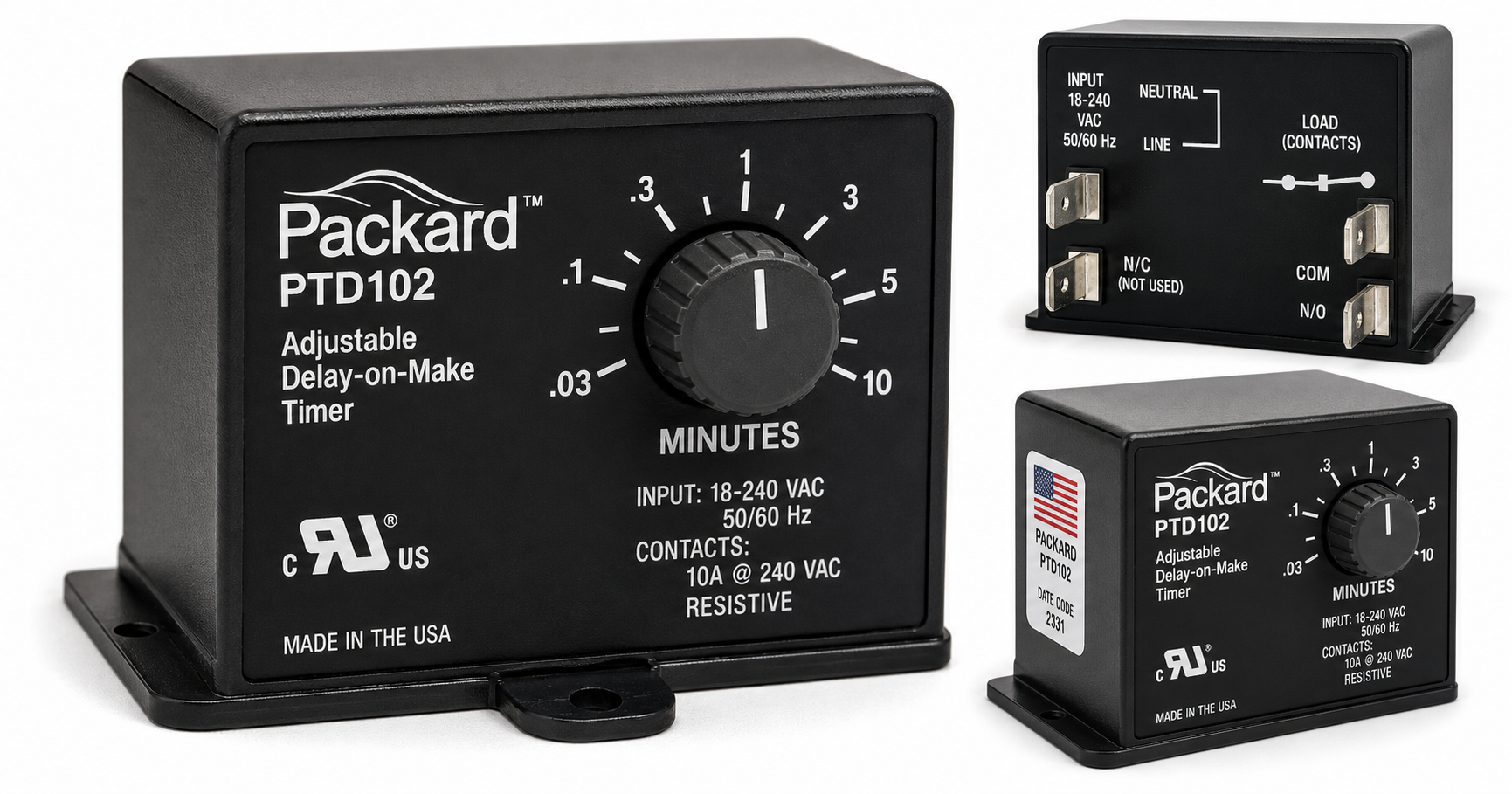
Product Context
The Packard PTD102 Adjustable Delay-on-Make Timer (ASIN B072C42X3H) is a compact control module intended for applications where a load should be energized only after a preset time delay. Typical use cases include HVAC blower motors, condensers, air compressors, pumps, and other equipment where staggered starts or short-cycle protection are important.
This module is built around a simple analog timing circuit with an adjustable delay range from approximately 0.03 minutes (about 2 seconds) up to 10 minutes. It targets technicians and experienced DIY users who are comfortable working inside electrical panels and need a cost-effective, single-function delay-on-make solution. On Amazon, it’s generally positioned as a budget-friendly timer, often found around $0.00, making it accessible for one-off repairs and small projects.
Feature Breakdown
1. Adjustable delay-on-make function
- Primary function is delay-on-make: once control power is applied, the timer waits for the set interval before closing its output contacts.
- Adjustable range: roughly 0.03–10 minutes, allowing both very short delays (for simple sequencing) and longer delays (for equipment protection or staged startup).
2. Compact module design
- Encapsulated, board-style module that can be mounted inside junction boxes, control panels, or air handler compartments.
- Small footprint makes it suitable for retrofits where space is limited.
3. Simple adjustment dial
- Front-mounted potentiometer (dial) used to set the delay.
- Marked time scale offers approximate guidance; exact timing is typically tuned by trial and error in the field.
4. Versatile control voltage and contacts
- Designed to work with common control voltages used in HVAC and appliance control circuits (under typical residential/light commercial conditions).
- Includes relay contacts suitable for switching low-current control loads, such as contactor coils or control relays, rather than large motors directly.
5. Packard brand support
- Packard is known in the HVAC replacement-parts space for capacitors, contactors, and relays, which simplifies sourcing compatible components for service work.
Performance Insights
In practical use, the PTD102 aims for dependable, repeatable delay-on-make performance without complex configuration.
- Timing accuracy: As an analog dial-based timer, accuracy is best considered approximate rather than laboratory-precise. For most HVAC and protection applications, being within a reasonable tolerance (e.g., a few seconds at shorter delays, modest percentage drift at longer delays) is sufficient.
- Repeatability: Once set, the delay is generally repeatable enough for everyday use, such as preventing short-cycling of a compressor or staggering motor starts to reduce inrush current.
- Stability over time: Under normal operating conditions, timing performance is stable; however, as with most analog timers, extreme temperature swings or component aging can cause minor drift.
- Electrical noise tolerance: The design is oriented toward typical HVAC and appliance environments where contactor operations and inductive loads are present. Correct wiring practices (good grounding, proper routing away from high-noise conductors) help maintain reliable operation.
For applications that demand exact, timestamp-level precision or logging, digital timers or PLC-based solutions are more appropriate. For most residential or light commercial control tasks, the PTD102’s performance is adequate and cost-effective.
Usability
Installation
- Intended for installation by qualified technicians or competent DIYers familiar with control wiring and safety protocols.
- The module usually requires panel mounting and screw or quick-connect wiring to existing control circuits.
- Clear labeling on the case (line, neutral/control, load/contacts) helps minimize wiring errors, though installers should always cross-check with the product sheet and system schematic.
Configuration and adjustment
- Single front dial simplifies setup:
- Turn clockwise for longer delay, counterclockwise for shorter.
- Fine-tuning typically involves setting an approximate value, then observing system behavior and making minor adjustments.
- No menus, programming steps, or multi-function modes to manage, which reduces the learning curve but also limits flexibility.
Everyday use
- Once installed and dialed in, the timer is effectively “set and forget.”
- Delay behavior is consistent: when the control circuit energizes, the PTD102 counts down and then closes its contacts; when power is removed, the contacts open without added delay (standard delay-on-make behavior).
- This consistency is particularly helpful for protecting compressors or pumps from rapid cycling after power blips or thermostat chatter.
Trade-offs
Strengths
- Simplicity: Single-function design and one adjustment knob reduce complexity during installation and troubleshooting.
- Compact size: Easy to fit into crowded panels and air handler compartments.
- Practical delay range: 0.03–10 minutes covers a wide range of typical HVAC and equipment-protection use cases.
- Budget-friendly: At around $0.00, it offers a low-cost way to add start delay or short-cycle protection without redesigning the entire control system.
Limitations
- Analog adjustment only: No digital readout or exact time-setting; achieving a precise delay may require testing and iterative tuning.
- Single function: Only provides delay-on-make; it does not support delay-on-break, interval timing, recycling, or multi-mode logic. Users needing multiple timing functions may require a more advanced timer.
- Limited switching capacity: Best suited for driving control-level loads (like contactor coils). High-current motor or heater loads should be switched with appropriate contactors or relays controlled by the PTD102.
- No advanced diagnostics: There are typically no status LEDs, fault codes, or communication interfaces, which can make troubleshooting slightly more manual.
Conclusion
The Packard PTD102 Adjustable Delay-on-Make Timer is a straightforward, single-purpose module tailored for installers and technically inclined users who need a reliable, budget-conscious way to introduce a power-on delay into HVAC and other control circuits. Its compact form factor, practical 0.03–10 minute range, and simple dial adjustment make it well suited for short-cycle protection, staged motor starts, and general equipment sequencing.
It does not attempt to replace more sophisticated digital or multi-function timers and lacks advanced features like programmable profiles, interval timing, or detailed diagnostics. However, for many real-world applications—especially in residential and light commercial HVAC—its simplicity is a benefit rather than a drawback.
If your project calls for a no-frills, delay-on-make timer that is easy to integrate into existing control wiring, the Packard PTD102 is a solid option to consider, particularly at its accessible Amazon price point of around $0.00.