
Humminbird 411660-1 Helix 5 CHIRP GPS G3 Fish Finder Review: Compact Sonar With Serious Mapping Power
Introduction
The Humminbird 411660-1 Helix 5 CHIRP GPS G3 Fish Finder is designed for anglers who want a capable sonar/GPS combo in a relatively small footprint. With a 5-inch color display, Dual Spectrum CHIRP 2D sonar, internal GPS, Humminbird Basemap, and AutoChart Live, it aims to deliver the essentials of modern fish-finding and navigation without the cost or bulk of larger units. Positioned around $309.00 on Amazon, it competes directly with other entry- to mid-level 5-inch units from brands like Garmin and Lowrance.
In this review, we’ll walk through setup, day-to-day use, and long-term performance to help you decide whether the Helix 5 CHIRP GPS G3 is the right fit for your boat, kayak, or small craft.
Setup / Getting Started
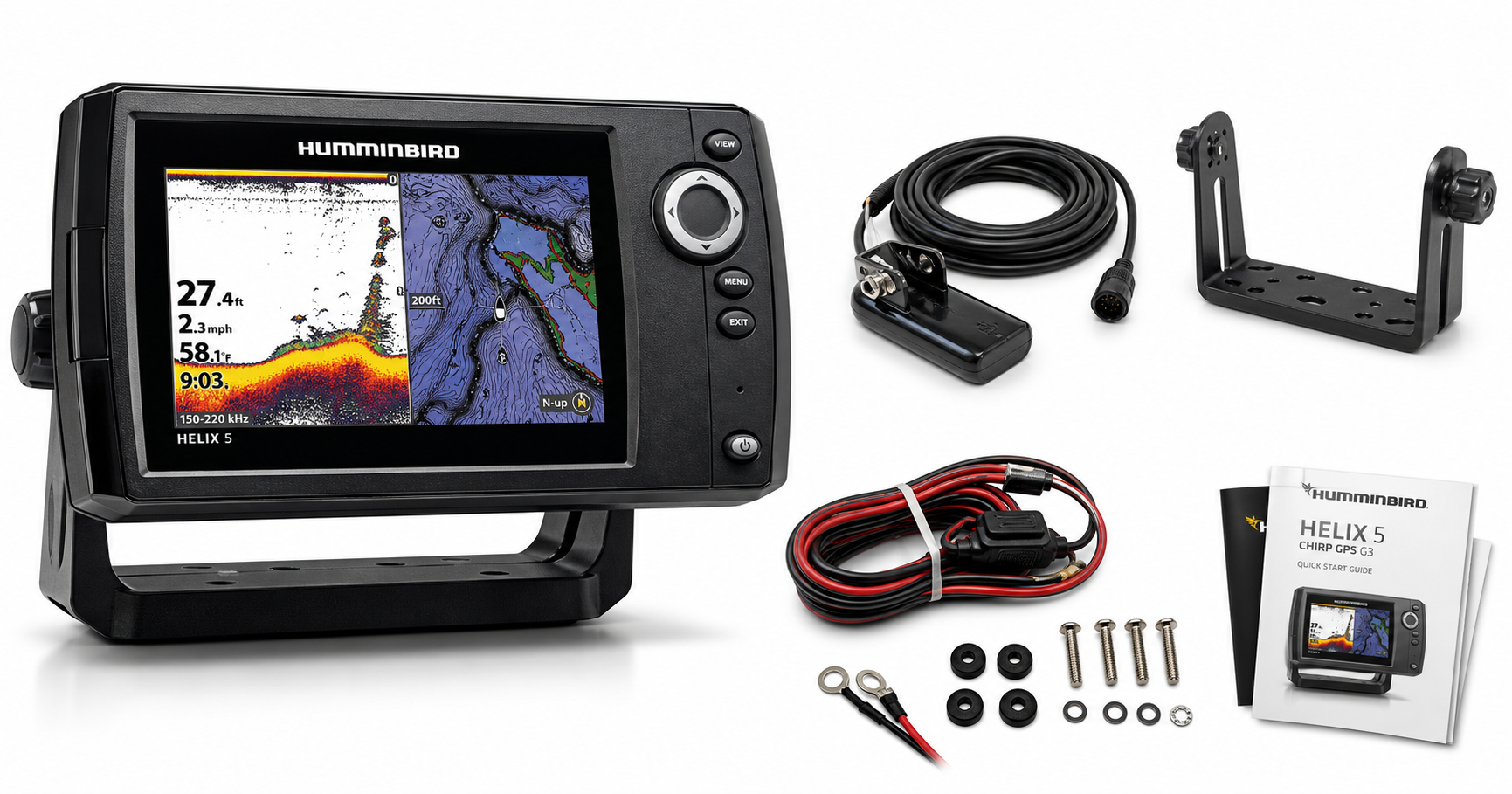
What’s in the box
Typical packages for the Humminbird 411660-1 Helix 5 CHIRP GPS G3 include:
- Helix 5 CHIRP GPS G3 head unit (5" color TFT display)
- Transom-mount Dual Spectrum CHIRP transducer
- Gimbal mounting bracket and hardware
- Power cable
- Documentation and quick-start guides
The unit is intended for permanent or semi-permanent mounting on a console or flat surface. A RAM or similar articulating mount can be added if you want more flexible positioning, especially on smaller boats or kayaks.
Physical installation
Mounting the head unit is straightforward:
- Choose a location with good visibility and minimal glare.
- Mark and drill mounting holes for the gimbal bracket.
- Attach the bracket and then the head unit, tightening it enough to prevent movement in chop but still allowing tilt adjustments.
Transducer installation is more critical for performance:
- Mount the included transom transducer low enough so that it stays in the water at speed but not so low that it’s vulnerable to impact.
- Aim for a level, bubble-free water flow ahead of the prop.
- Keep it away from steps, strakes, or hull features that can introduce turbulence.
Kayak anglers often adapt the transducer using scupper mounts, arm mounts off a gear track, or in-hull (shoot-through) installs. While Humminbird doesn’t bundle a dedicated kayak kit with this specific model, the compact transducer makes DIY mounting relatively manageable.
Wiring and power
The Helix 5 CHIRP GPS G3 draws modest current and can run comfortably from a small 12V battery. For boats, it typically ties into the main 12V system with an in-line fuse. For kayaks, a sealed lead-acid or LiFePO4 battery in the 7–15Ah range is usually sufficient for all-day use.
Basic wiring steps:
- Connect the power leads to a fused 12V source (respecting polarity).
- Plug in the transducer and secure the cable along the transom and up the console or gunwale.
- Tidy excess cable with clips or zip ties to avoid snags.
Once powered, the unit boots quickly and walks you through basic language and unit preferences.
Daily Usage
Interface and controls
The Helix 5 series uses a soft-key keypad interface rather than a touchscreen. The X-Press Menu system is focused on quick access to commonly changed settings like sensitivity, range, and chart zoom.
In daily use:
- The 5-inch screen offers good readability for one- or two-panel views (e.g., sonar + chart), though three-way splits can feel cramped.
- Physical buttons are easy to operate with wet or gloved hands and tend to be more reliable in spray than touchscreens.
- Menus are structured logically, but there is still a learning curve—especially for new users diving into AutoChart Live or advanced sonar settings.
On-the-water workflow
A common day on the water with the Helix 5 CHIRP GPS G3 looks like this:
- Power on and acquire GPS: Within a minute or so, you have position, speed, and heading (over ground).
- Navigate using Humminbird Basemap: The built-in basemap provides general contours, shorelines, and navigation data for many U.S. waters. It’s not as detailed as premium charts but is often sufficient for basic positioning and route-following.
- Mark waypoints: With a single keypress, you can drop waypoints on schools of fish, structure, or productive drifts. Returning to these marks on later trips is straightforward via the chart screen.
- Adjust sonar views: Switch between wide and narrow CHIRP beams, zoom into the water column, and tweak sensitivity or interference rejection as conditions change.
The combination of chart and sonar in split-screen mode is particularly useful when trolling or scouting new water, allowing you to see both bottom structure and your position on the map simultaneously.
Performance & Reliability
Sonar performance (Dual Spectrum CHIRP)
The core of this model is Dual Spectrum CHIRP 2D sonar. In practice, that means:
- Better target separation than traditional single-frequency 2D sonar, which helps distinguish individual fish from bait balls or nearby structure.
- Two primary modes: a wide beam for searching and a narrow, more precise beam for detailed viewing under the boat.
- Depth and clarity: It performs well across common freshwater depths and typical inshore saltwater applications, with crisp arches and clear bottom returns when the transducer is properly mounted.
For most anglers targeting bass, walleye, panfish, or inland lake species, the sonar capability is more than sufficient. The main limitation is that this particular variant does not add Down Imaging or Side Imaging—if you rely heavily on picture-like views of structure or want to scan large areas horizontally, you’d need a higher-tier Helix model.
GPS and mapping
The internal GPS acquires satellites reliably and provides:
- Position, speed, and track logging for reviewing your path.
- Humminbird Basemap with coverage for many popular lakes and coastal areas.
- Waypoint and route management for returning to specific locations.
- AutoChart Live to create your own contour maps in real time as you fish.
AutoChart Live can be a significant asset on under-mapped or smaller bodies of water. Over time, you build up high-resolution depth maps that stay on your unit (and can be backed up via SD card). This feature alone is a strong value add in the Helix 5 line.
The Helix 5 CHIRP GPS G3 is also compatible with premium chart cards from Humminbird and Navionics. If you routinely fish large reservoirs, expansive river systems, or complex coastal waters, an upgrade to premium charts can dramatically improve situational awareness.
Reliability and durability
Humminbird’s Helix series has a long track record on freshwater boats, and the 5-inch G3 continues that pattern:
- The housing feels solid, with gasketed seams and a robust bracket.
- Button controls are generally durable and less prone to failure in harsh environments than some touch screens.
- The transducer is the main breakage risk if struck, so careful placement is important.
Firmware updates, when available, can be applied via SD card, adding periodic refinements and compatibility tweaks.
What Works Well
- Strong value for sonar + GPS combo: Even around the $309.00 mark, the Helix 5 CHIRP GPS G3 includes features—Dual Spectrum CHIRP, AutoChart Live, Basemap, and chart card support—that cover most needs for small-boat anglers.
- Dual Spectrum CHIRP performance: Clear arches, solid bottom definition, and better-than-basic target separation make it a meaningful upgrade over older non-CHIRP units.
- Built-in mapping and live mapping: Out-of-the-box basemaps reduce the need for immediate chart-card purchases, while AutoChart Live helps you gradually create custom contour maps.
- Compact footprint: The 5-inch display fits consoles and kayaks where larger units would be awkward or impossible to mount.
- Button-driven interface: Reliable, glove-friendly controls that remain usable in cold, wet conditions.
What Could Be Improved
- No Down or Side Imaging on this variant: Anglers who prioritize detailed structure imaging or wide-area scanning may find the absence of DI/SI limiting and should consider a Helix model with these features.
- Screen size for split views: While usable, the 5-inch screen can feel cramped when running split sonar/chart views or adding zoomed-in panes.
- Learning curve for advanced features: AutoChart Live and finer sonar adjustments can be intimidating to new users; more guided on-screen help or presets would be welcome.
- Limited networking/expandability: As a compact, budget-oriented unit, it doesn’t offer the networking flexibility (such as Ethernet sharing across multiple units) found on larger Helix or Apex models.
Overall Impression
The Humminbird 411660-1 Helix 5 CHIRP GPS G3 is a well-balanced fish finder for anglers who want reliable, modern sonar and integrated GPS in a compact form and at a relatively accessible price point. Dual Spectrum CHIRP provides clear, confident fish and bottom readings, while Humminbird Basemap and AutoChart Live deliver robust on-the-water navigation and mapping without requiring immediate investment in premium chart cards.
It’s best suited to:
- Small to mid-size freshwater boats and tiller rigs.
- Kayak anglers who value mapping and GPS but have limited dash space.
- Anglers upgrading from older non-CHIRP or sonar-only units who want a capable all-rounder.
If you need Down Imaging, Side Imaging, or a larger screen, you’ll want to look up the higher-tier Helix models. But if your priority is a solid mix of sonar performance, dependable GPS, and live mapping in a compact package, the Helix 5 CHIRP GPS G3 offers a compelling blend of features and value.