
Apple AirTag (2nd Generation) 4‑Pack Review: Subtle but Meaningful Upgrades for Apple’s Item Tracker
Introduction
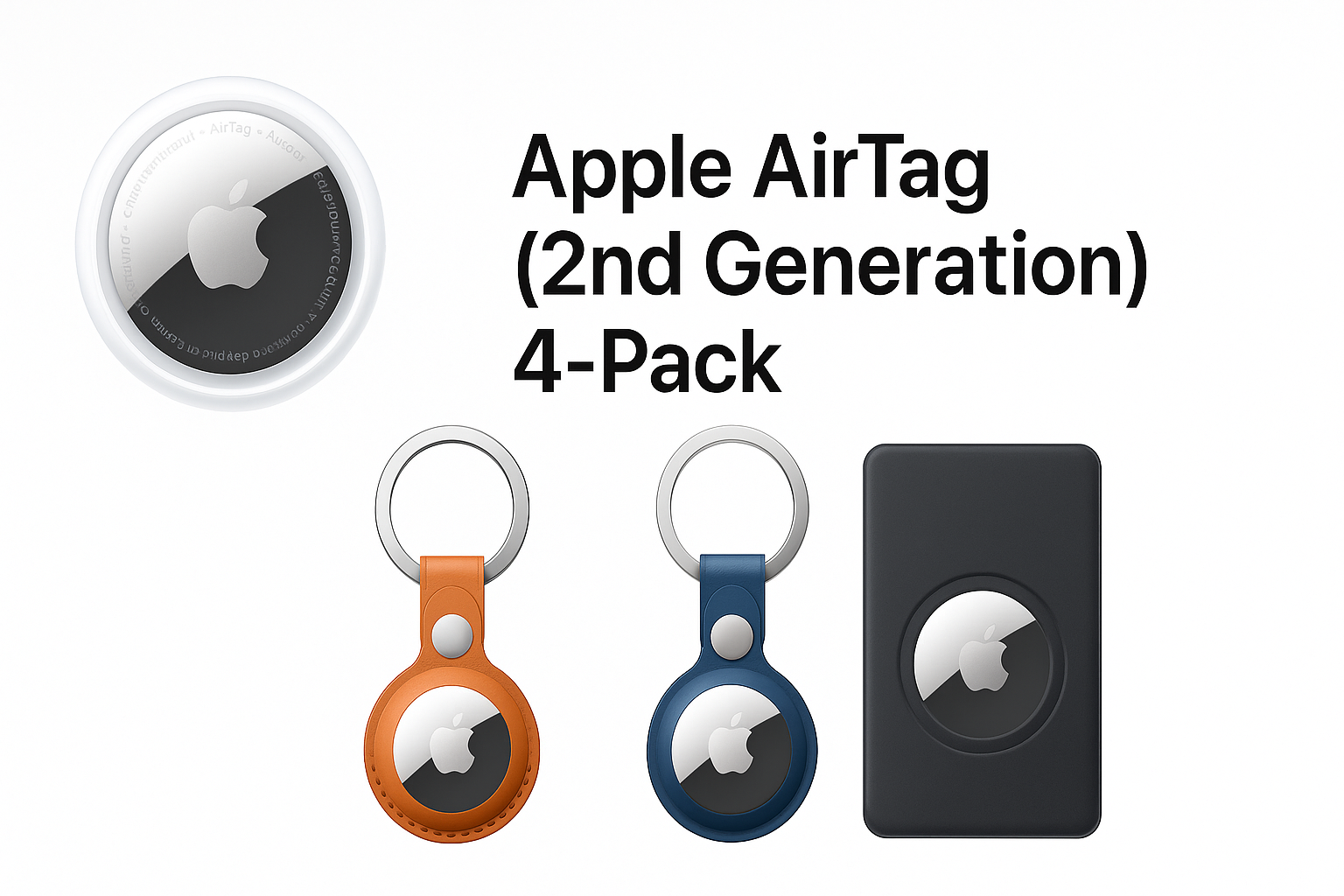
The Apple AirTag (2nd Generation) 4‑Pack is Apple’s latest iteration of its compact item tracker, designed to help you locate everyday essentials like keys, wallets, backpacks, and luggage using the Find My app on iPhone, iPad, and Apple Watch. While it looks nearly identical to the original AirTag, this second‑generation model focuses on more accurate and flexible tracking, a louder speaker, and incremental improvements to sustainability and ecosystem integration.
For buyers considering a multi‑pack to cover several items at once, this 4‑pack provides a convenient way to outfit your most important belongings and is typically positioned as a better overall value than buying individual units, with a bundle cost often around $89.00 for all four.
Product overview and key features
At a glance, the 2nd‑gen AirTag keeps the same compact, circular form factor and white‑and‑metal finish as the original, making it easy to slip into a wallet pocket (with an accessory), attach to a keychain, or drop into a bag. The physical design changes are subtle; most of the upgrades are under the hood.
Key features include:
-
Compact, durable design
The AirTag (2nd generation) maintains a diameter of about 31.9 mm and a height of roughly 8 mm, with a lightweight build that fits easily into small spaces. It’s rated IP67 for water and dust resistance, so it can withstand brief submersion and everyday splashes. -
Updated Ultra Wideband (UWB) for expanded Precision Finding
The headline change is Apple’s second‑generation Ultra Wideband chip, which enables an expanded Precision Finding range—up to approximately 1.5× farther than the original when paired with supported iPhone and Apple Watch models. This helps you get directional guidance to an AirTag from farther away, particularly useful in large homes, buildings, or crowded areas. -
Louder built‑in speaker
The 2nd‑gen AirTag includes a louder, more prominent speaker to make the device easier to hear when you trigger a sound in the Find My app. This is a practical quality‑of‑life upgrade for finding items under cushions, inside bags, or in noisy environments. -
Find My network integration
Like the first generation, AirTag relies on Apple’s vast Find My network. Any nearby Apple device participating in the network can securely relay its location back to you, without revealing personal data to other users. This makes it particularly effective in urban areas, airports, hotels, and other dense environments where Apple devices are common. -
User‑replaceable battery
AirTag (2nd generation) still uses a standard CR2032 coin cell battery that you can replace yourself. Apple’s testing indicates roughly a year of typical use per battery, depending on how often you play sounds, use Precision Finding, and how frequently it’s located by nearby devices. -
Privacy and anti‑stalking safeguards
Apple continues to refine AirTag’s safety features, including alerts if an unknown AirTag appears to be traveling with you, periodic audible alerts from unregistered tags, and guidance integrated into iOS and iPadOS. These features are designed to reduce misuse for unwanted tracking. -
Compatibility and requirements
To set up and use an AirTag (2nd generation), you need an Apple ID and a compatible iPhone or iPad running a recent version of iOS or iPadOS. Precision Finding with the expanded range requires newer devices equipped with Apple’s second‑generation UWB chip; on older but still supported models, AirTag falls back to Bluetooth‑based proximity and standard map‑based location.
Performance and user experience
Setup and everyday usage
Setting up the AirTag (2nd Generation) 4‑Pack is intentionally simple. Bringing an AirTag near an unlocked iPhone or iPad automatically triggers a setup prompt. From there, you assign a name and icon (e.g., “Keys,” “Backpack,” “Wallet,” “Luggage”) and associate it with your Apple ID. The process is fast and usually completes in seconds.
Once configured, each AirTag appears in the Items tab of the Find My app, where you can:
- View its last known location on a map.
- Get directions to its approximate location via Apple Maps.
- Trigger a sound on the AirTag to help locate it nearby.
- Use Precision Finding (with compatible devices) for directional arrows and distance estimates.
- Enable Lost Mode, which locks the AirTag to your Apple ID and can display a custom message and phone number when someone scans it via NFC.
In daily use, the experience is largely hands‑off: the tags sit quietly until you misplace something, at which point the combination of sound, proximity cues, and the Find My network becomes valuable.
Precision Finding and range
The main performance upgrade is the new UWB chip, which extends the effective range of Precision Finding. When within range and using a supported iPhone or Apple Watch, the screen provides an arrow, distance readout, and haptic feedback guiding you directly to the AirTag.
In practice, the improvements manifest as:
- Better performance in larger spaces: You can often start Precision Finding from farther away, reducing the time spent walking around waiting for the feature to engage.
- More stable directional guidance: Direction and distance updates feel smoother and more responsive once you’re in range.
- Improved experience on Apple Watch (with compatible models): Being able to track an AirTag from your wrist is especially useful when your hands are full or when you’re traveling and don’t want to constantly hold your phone.
For users on older devices without the latest UWB hardware, AirTag continues to work but behaves more like a traditional Bluetooth tracker: you rely on approximate location on a map, sound playback, and proximity notifications rather than precise directional arrows at long range.
Sound and audibility
The louder internal speaker is another practical change. On the previous generation, users sometimes reported difficulty hearing their AirTags in noisy rooms or when buried deeply in bags. The 2nd‑generation model addresses this by increasing output and refining sound patterns so they cut through ambient noise more effectively.
This is particularly noticeable when:
- Locating keys lost somewhere in a cluttered living room.
- Trying to find a suitcase in a pile of similar bags.
- Tracking down a small item in a car or garage where echoes and background noise can mask quieter sounds.
Battery life and maintenance
The inclusion of a standard CR2032 coin cell remains a strong point. Replacements are inexpensive and widely available, and swapping the battery is straightforward: twist the back cover, replace the cell, and snap it closed. Under typical use conditions (occasional sound playback and periodic location pings), most users can expect around a year of life before seeing a low‑battery alert in the Find My app.
Privacy, safety, and limitations
Apple has continued iterating on AirTag’s safety framework. If an AirTag not registered to your Apple ID appears to travel with you over time, your iPhone will display an alert and offer guidance on how to locate and disable it. Similar protections exist for Android users via a dedicated app and OS‑level detection in newer Android versions.
However, there are important limitations to understand:
- Not a real‑time GPS tracker: AirTag depends on nearby Apple devices to relay its location. In areas with sparse Apple device coverage, updates can be infrequent.
- Not intended for people or pets: Apple’s documentation explicitly positions AirTag for items only. For children, vulnerable individuals, or pets, specialized GPS trackers with continuous cellular connectivity may be more appropriate.
- Requires Apple ecosystem: To get the best experience (including Precision Finding and tight integration), you must be within Apple’s hardware and software ecosystem. Mixed or Android‑only households won’t get full value.
Pros and cons
Pros
- Improved Precision Finding with expanded range on newer iPhones and compatible Apple Watches, making it easier to track items indoors and in crowded spaces.
- Louder built‑in speaker that makes the AirTag easier to hear when buried in bags or under furniture.
- Deep Find My network integration, leveraging millions of Apple devices for location updates without exposing personal information.
- Simple, reliable one‑tap setup and intuitive management through the Find My app.
- Compact, water‑ and dust‑resistant design suitable for keychains, wallets (with accessories), luggage tags, and more.
- User‑replaceable CR2032 battery with around a year of typical life, reducing long‑term ownership cost.
- Strong privacy and anti‑stalking features compared to many third‑party trackers.
- Environmentally conscious design with increased use of recycled materials and fiber‑based packaging.
- 4‑Pack offers better overall value than buying single units individually, especially when frequently found near $89.00.
Cons
- Best features require newer Apple hardware, particularly for the extended UWB Precision Finding range and Apple Watch integration.
- Limited usefulness in non‑Apple ecosystems; Android users have fewer features and rely primarily on detection rather than ownership.
- No built‑in attachment point, so accessories (key rings, loops, card‑style holders) are often required and add to the total cost.
- Not a substitute for dedicated GPS trackers in scenarios needing constant, wide‑area tracking (for example, vehicles, pets, or high‑value shipments over long distances).
- Visually similar to the first generation, making it hard to distinguish at a glance if you own both versions.
Conclusion and recommendation
The Apple AirTag (2nd Generation) 4‑Pack is an incremental but meaningful upgrade to Apple’s item‑tracking ecosystem. The improved Ultra Wideband chip and expanded Precision Finding range significantly refine the experience for users with compatible iPhones and Apple Watches, while the louder speaker and continued focus on privacy, safety, and sustainability round out the package.
If you already live inside the Apple ecosystem and want reliable, low‑maintenance trackers for your keys, wallet, bags, and luggage, this 4‑pack is an excellent starting point. The bundle pricing—commonly around $89.00 for four—tends to offer better per‑tag value than buying individual units, and it gives you enough tags to cover multiple frequently misplaced items.
Owners of the original AirTag may not need to rush to upgrade unless they specifically want the extended Precision Finding range, louder speaker, or Apple Watch‑based finding with supported models. However, for new buyers or those expanding their tracking setup, the Apple AirTag (2nd Generation) 4‑Pack stands out as one of the most polished and seamlessly integrated item‑tracking solutions available for iPhone and iPad users.