
TP-Link Tapo C100 Review: A Budget 1080p Indoor Camera for Everyday Home Monitoring
Product Context
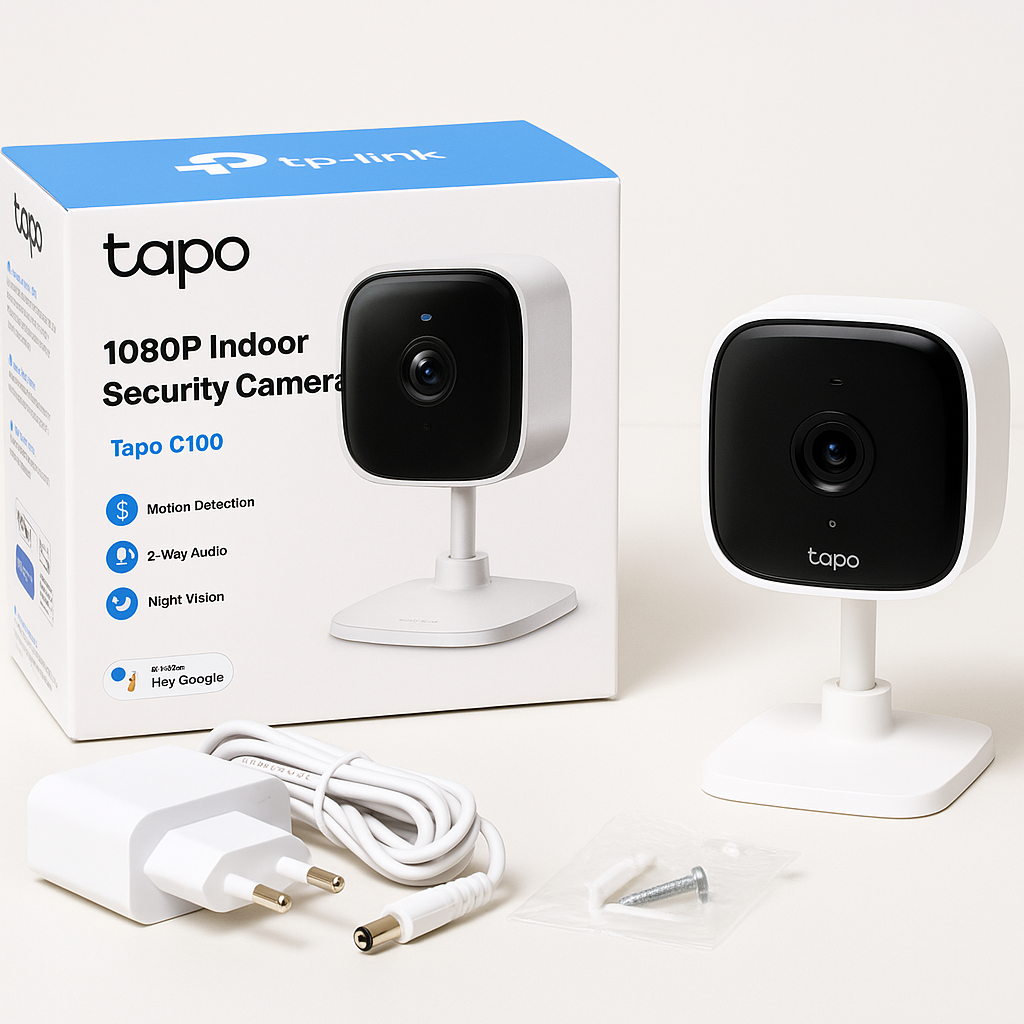
The TP-Link Tapo 1080P Indoor Security Camera (Tapo C100) is an entry‑level, Wi‑Fi–connected indoor camera designed for everyday monitoring tasks: acting as a baby monitor, a dog/pet camera, or a simple home security camera for hallways, living rooms, or home offices.
Typical use cases include:
- Keeping an eye on a sleeping baby, with night vision and baby‑crying sound detection (on newer firmware/app versions).
- Monitoring pets while you’re away, thanks to motion alerts and two‑way audio.
- Basic security coverage for entryways or indoor common areas.
On paper, it competes in the low‑cost indoor camera segment by combining:
- 1080p Full HD video
- Infrared night vision up to around 30–40 ft
- Motion detection and notifications
- Two‑way audio with a built‑in siren
- Local microSD recording (plus optional cloud storage)
- Compatibility with Alexa and Google Home
This review looks at how these capabilities hold up in real‑world use, who the Tapo C100 is best suited for, and where its limitations appear.
Note: Pricing varies by retailer and promotions. At the time of writing, the single‑camera pack is typically positioned in the budget range (for example, around $15.96 on Amazon), which is a key part of its appeal.
Feature Breakdown
Core Video and Imaging
- Resolution: 1080p Full HD (1920 × 1080)
- Sensor: 1/3‑inch class CMOS sensor
- Field of view: Roughly 117° diagonal, ~99° horizontal
- Frame rate: Up to 30 fps (often defaults to 15 fps to save bandwidth)
For an indoor camera at this level, 1080p is standard rather than cutting edge, but it’s generally adequate for identifying faces and monitoring activity in small‑to‑medium rooms.
Night Vision
- Uses IR LEDs for black‑and‑white night vision
- Rated visibility distance up to approximately 30–40 ft (9–12 m) in a typical indoor space
The night image is monochrome but clear enough for monitoring sleep or checking motion in low light. For a nursery, hallway, or living room, the night performance is acceptable for the price category.
Motion and Sound Detection
- Motion detection with configurable activity zones in the Tapo app
- Configurable notification sensitivity, so you can reduce false alerts from minor movements
- On newer firmware/app combos, person detection and baby crying detection may be available as enhanced features via TP‑Link’s ecosystem and/or paid services
For a baby or pet monitoring use case, the ability to tune zones (e.g., just the crib area, or just a doorway) is useful to prevent constant alerts from background movement like curtains or TV screens.
Two‑Way Audio and Siren
- Built‑in microphone and speaker for real‑time two‑way audio
- Siren / sound & light alarm that can be triggered manually or on certain events
Two‑way audio is strong enough for short conversations: calming a pet, telling kids dinner is ready, or speaking to someone who just walked into the monitored room. The siren is relatively loud at close range and intended as a deterrent for intruders or as an attention‑getting alert.
Storage Options
- Local storage: microSD card slot on the camera
- Supports large‑capacity cards (up to several hundred gigabytes, depending on revision)
- Continuous, scheduled, or event‑triggered recording options
- Cloud storage: Optional cloud plan via TP‑Link’s Tapo service (subscription required)
Local recording is one of the biggest advantages at this price tier. It lets you record even if you don’t subscribe to a cloud service, and it can still capture events during short internet outages (provided the camera stays powered and connected to the local network).
Smart Home and App Integration
- App: Tapo app (iOS and Android) for setup, live view, playback, and configuration
- Voice Assistants: Works with Amazon Alexa and Google Home/Assistant, so you can:
- Pull up the camera feed on compatible smart displays (e.g., Echo Show, Nest Hub)
- Use voice commands to show or hide the feed
The Tapo app also supports multi‑camera views, making it easier to scale up to several C100 units or mix with other Tapo ecosystem devices.
Performance Insights
Video Quality in Daylight
In well‑lit indoor environments, the Tapo C100 produces reasonably sharp 1080p footage. The wide field of view is sufficient to cover most small rooms from a corner or shelf placement.
- Detail: Faces and objects within typical indoor distances (6–15 ft) are recognizable.
- Color & contrast: Accurate enough for home monitoring, though not on par with higher‑end or 2K/4K cameras.
- Latency: There is a noticeable but acceptable delay on live view, common for cloud‑connected Wi‑Fi cameras.
For checking on kids or pets, this level of quality is usually more than adequate; for high‑detail forensic security footage, it’s on the basic side.
Low‑Light and Night Performance
When ambient light drops, the camera switches to IR night vision, producing grayscale footage:
- Brightness: Sufficient to see an entire small or medium room, especially if the camera is pointed inward rather than at a bright window.
- Sharpness: Good enough to distinguish movement and recognize people, but with some reduction in fine detail compared to daytime color.
For baby monitoring, the night view is a practical fit: you can confirm whether a child is awake, crying, or has moved into an unsafe position, though tiny facial expressions are harder to read than on higher‑resolution sensors.
Motion Detection and Alerts Reliability
The motion detection system is generally dependable when tuned correctly:
- Activity zones help cut down on false positives from windows or other irrelevant areas.
- Sensitivity controls allow users to trade off between catching every minor movement and avoiding notification fatigue.
In networks with stable Wi‑Fi, push notifications typically arrive within a few seconds. If your Wi‑Fi or internet connection is weak or intermittent, delay or missed notifications become more likely, as with any fully cloud‑connected camera.
Audio Quality and Siren Effectiveness
- Mic performance: Picks up voices and environmental noise clearly enough for conversations in a quiet to moderately noisy room.
- Speaker performance: Understandable speech and alerts, though not hi‑fi. There may be some echo or compression artifacts.
- Siren: Noticeably loud at close range and adequate to startle someone in the monitored room or to grab attention in a small home.
For baby monitoring, be cautious with the siren feature—it’s best avoided around sleeping infants and used instead as a security‑oriented function for other rooms.
Usability
Setup and Installation
The Tapo C100 is designed for straightforward DIY setup:
- Physical setup: Plug in the included power adapter and position the camera on a flat surface or mount it using the supplied hardware (screws, anchors, mounting template).
- App pairing: Download the Tapo app, create or sign into a TP‑Link account, and follow the guided steps to add the camera via Wi‑Fi.
- Configuration: Name the camera (e.g., “Nursery,” “Living Room”), set up motion zones, notification preferences, recording schedules, and microSD formatting.
Most users can complete setup in under 15–20 minutes, assuming a stable 2.4 GHz Wi‑Fi network and typical home router configurations.
Daily Use
In everyday operation, the experience is app‑centric:
- Live view: Quickly check real‑time video, with options to switch between SD/HD quality to manage bandwidth.
- Playback: Review recordings stored locally on the microSD card or in the cloud, with timeline scrubbing and event filters.
- Notifications: Receive alerts on smartphones when motion or sound is detected, then tap through to the live or recorded view.
Integration with Alexa and Google Home makes it more convenient for families who already use smart speakers or displays. Saying “show the baby camera on the living room TV” (via a compatible device) is often easier than reaching for the phone.
Reliability Considerations
The C100 is highly dependent on network quality:
- Stable Wi‑Fi is crucial for smooth live viewing and timely alerts.
- Local recording to microSD can continue even during brief internet outages, but app connectivity and cloud features will be impacted when the camera loses network access.
Users in homes with crowded Wi‑Fi networks, thick walls, or long distances from the router may need to consider relocating the router, using a mesh Wi‑Fi system, or placing the camera closer to the access point.
Trade-offs
Strengths
- Budget‑friendly: The Tapo C100’s typical price point (around $15.96 for a single unit on Amazon) makes it attractive for buyers wanting multiple cameras or an inexpensive starter setup.
- Local storage without mandatory subscriptions: microSD recording reduces reliance on monthly cloud fees.
- Solid feature set for the price: 1080p, night vision, motion alerts, two‑way audio, and siren are a strong bundle in this segment.
- Good fit for baby/pet monitoring: The combination of night vision, motion detection, and optional baby‑cry detection is tailored to these scenarios.
- App ecosystem and voice assistant support: Easy integration with Alexa and Google Home adds convenience.
Limitations
- 1080p resolution only: Adequate, but less detailed than 2K or 4K alternatives—fine for general monitoring, less ideal for forensic‑grade security footage.
- Indoor‑only design: No weatherproofing; not suitable for outdoor or semi‑outdoor locations like balconies exposed to the elements.
- Wi‑Fi dependence: Performance and reliability are tightly tied to the quality of your home network.
- Ecosystem lock‑in: Works best when you adopt the broader Tapo ecosystem. Integration with third‑party NVRs or fully local systems is limited and may require workarounds.
- Limited advanced analytics: While there are motion, sound, and in some regions person or baby‑cry detection options, you don’t get the more sophisticated AI features found on higher‑end cameras.
When It’s a Good Fit
Choose the Tapo C100 if you:
- Want a low‑cost indoor camera for basic monitoring.
- Prefer local microSD storage and don’t want to rely entirely on cloud subscriptions.
- Already use (or plan to use) Alexa or Google Home and want simple voice‑accessed live views.
- Need a baby monitor or pet camera with solid night vision and two‑way audio.
When to Consider Alternatives
You might want to look elsewhere if you:
- Need higher resolution (2K/4K) for detailed identification or wide‑area coverage.
- Require a weatherproof outdoor camera.
- Want advanced AI features, deep smart‑home automation, or tight integration with local NVR/surveillance platforms.
- Have very unreliable Wi‑Fi and prefer a more locally controlled or wired solution.
Conclusion
The TP-Link Tapo C100 1080P Indoor Security Camera is a practical, budget‑oriented choice for households that need basic, always‑on monitoring of babies, pets, or key indoor areas. Its mix of 1080p video, night vision, motion and sound alerts, two‑way audio, and local microSD storage provides strong value for its typical asking price of around $15.96.
It’s not designed to compete with higher‑end 2K or 4K cameras, nor does it target fully local, professional‑grade security systems. Instead, it focuses on being easy to install, straightforward to use, and affordable to deploy in multiples.
If your priorities are simplicity, low cost, and sufficient indoor monitoring quality, the Tapo C100 fits those needs well. If you need higher resolution, advanced AI analytics, or outdoor‑ready hardware, it may be worth stepping up to more advanced models in the TP‑Link Tapo lineup or from competing brands.