
She’s Birdie 3.0 Personal Safety Alarm (Aqua Blue) Review: Compact Protection with a Louder, Smarter Design
Introduction
Personal safety devices are increasingly becoming part of everyday carry, especially for women who want a simple, non-weapon option they can keep on hand. The She’s Birdie 3.0 New Version – The Original Personal Safety Alarm for Women by Women (Aqua Blue) is the latest iteration of Birdie’s keychain alarm, pairing a loud siren with a strobe light and rechargeable battery in a small, colorful housing.
In this review, we’ll look at how Birdie 3.0 handles setup, daily use, and real-world practicality, and whether it’s a strong choice if you’re considering a compact personal alarm around the $29.94 mark.
Setup / Getting Started
Out of the box, the Birdie 3.0 experience is intentionally minimal.
-
What’s included
- Birdie Original 3.0 device (Aqua Blue housing)
- Brass keychain/clip
- USB charging cable
- Quick-start instructions
-
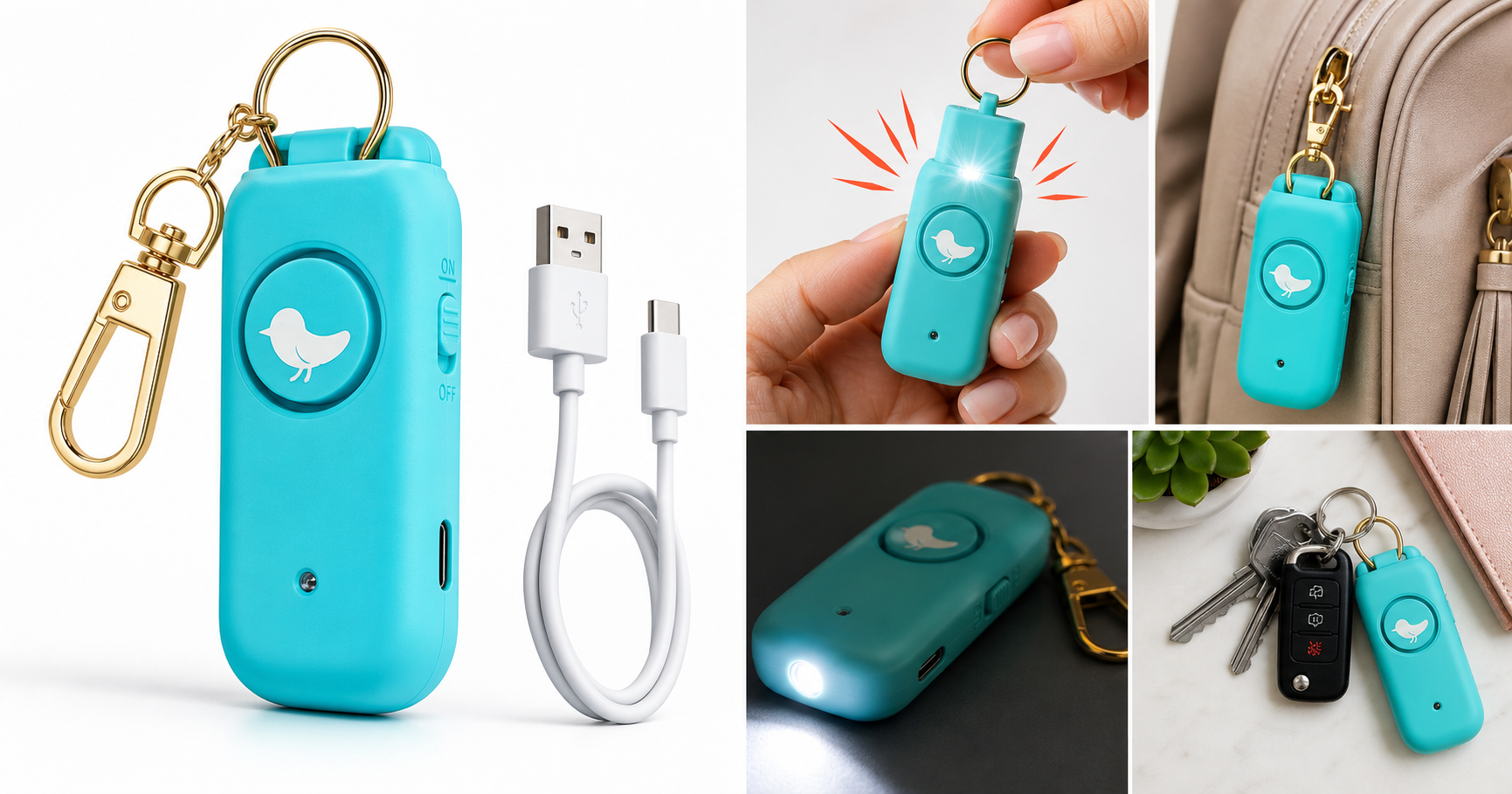
Build and size
The casing is slim and lightweight, roughly the size of a small USB power bank, with dimensions around 3.7 x 1.25 x 0.6 inches and a weight under half an ounce. This makes it unobtrusive on a keychain, bag, or lanyard, and the soft-touch finish plus rounded edges help it feel more like an accessory than a tool. -
Initial charging
Birdie 3.0 uses a built-in rechargeable Li‑ion battery. Before first use, it’s recommended to plug it in until the charge indicator LED turns from red (charging) to green (full). A full charge supports up to about 120 minutes of continuous sound and light, which is more than enough for short alarm activations but also means you won’t need to charge it frequently under normal use. -
Power and basic controls
- On/Off switch: A small slider turns the device on. The siren and strobe only work when it’s in the "on" position.
- Top pin/ring: Pulling the top section (attached to the ring) triggers the siren and strobe. Pushing it back until it clicks stops the alarm.
- Flashlight button: A separate button activates the white LED flashlight while held down, even when the main alarm function is switched off.
The learning curve is essentially zero; most users will understand the operation in seconds, which is important for a device you may need to use under stress.
Daily Usage
Birdie 3.0 is designed to be carried all the time, not stashed in a bag pocket and forgotten.
- Carry options
- On keys, using the included brass keychain ring
- Clipped to a purse or backpack strap for faster access
- On a belt loop or lanyard when jogging or walking the dog
Because it’s small and weighs very little, it doesn’t add much bulk to a keyring. The brightly colored Aqua Blue shell makes it easier to spot in a crowded bag and gives it a more approachable look than tactical-style devices.
-
Using the alarm in real life
In an emergency, you’re meant to grab and pull the top ring sharply to trigger the alarm and strobe light. The motion is simple and can usually be done one‑handed. Since the siren is rated around 130 dB, it’s extremely loud at close range—enough to draw attention in public places, parking lots, or on a street, and to potentially startle or disorient someone who’s too close.Deactivation is done by pushing the top pin back in firmly until you hear or feel a click. Practicing this once or twice in a controlled environment (ideally with your fingers over the speaker to dampen the sound) is wise so you’re not surprised by the volume later.
-
Flashlight as an everyday tool
The small LED flashlight is not a replacement for a dedicated torch, but it’s bright enough for:- Finding a keyhole at night
- Checking under car seats
- Navigating a dark entryway or stairwell
Because the flashlight operates even when the main alarm is switched off, you can use it routinely without worrying about triggering the siren.
-
Battery and charging habits
With no constant wireless or smart connectivity features, the Birdie 3.0 battery drains mainly when the alarm or flashlight is used. The device includes a low‑battery indicator: when the charge falls to around 10%, a red light blinks periodically to remind you to recharge. For many users, a monthly or every‑few‑weeks top‑up is ample, depending on flashlight use.
Performance & Reliability
A personal alarm is only useful if it’s loud, simple to activate, and dependable.
-
Siren loudness
Birdie 3.0 is specified at about 130 dB, comparable to a jet engine at a distance. In practice, that means:- It’s painfully loud at arm’s length, demanding attention.
- It can be heard across a typical parking lot or along a residential street, especially at night.
Covering the speaker with your hand or clothing can reduce the perceived volume somewhat, so when practicing, it’s a good idea to keep the speaker unobstructed to understand its true output.
-
Strobe light visibility
The integrated high‑intensity strobe is effective in low‑light environments. In a dark garage, side street, or hallway, the blinking light helps make your position obvious to bystanders or first responders far more than sound alone. In bright daylight, the visual impact is less dramatic but still noticeable at closer ranges. -
Rechargeable battery behavior
Compared to earlier versions that used replaceable batteries, the built‑in rechargeable pack reduces ongoing maintenance and ensures consistent performance. Up to 120 minutes of continuous running time is generous—using the alarm for even 30 seconds at a time leaves plenty of emergency runtime. -
Durability and weather resistance
The plastic housing and keychain hardware feel suitable for regular everyday carry, with enough robustness for keys, bags, and light bumps. It’s not advertised as fully waterproof or shock‑proof, so it’s best treated as water‑resistant for rain and splashes rather than submersion. -
Reliability considerations As a simple electronic device without complex software, there’s not much to misconfigure. If it’s charged, switched on, and has an intact pin mechanism, it generally either works or it doesn’t. Keeping an eye on the charge indicator and occasionally testing the alarm (briefly and in a controlled setting) is a good practice.
What Works Well
-
Very loud alarm
The 130 dB siren is the core of the product and it delivers. At close range, it’s uncomfortably loud, which is exactly the point—drawing attention and making it harder for someone to act unnoticed. -
Simple, intuitive operation
The pull‑to‑activate, push‑to‑deactivate mechanism is about as straightforward as it gets. There are no modes, apps, or complex settings to remember during a stressful moment. -
Rechargeable, longer‑lasting power
The switch to a rechargeable Li‑ion battery in the Birdie 3.0 reduces the need to track disposable cell replacements and supports long total alarm time. -
Compact, lightweight design
Its small footprint and low weight make it realistic to carry daily on a keychain or bag without feeling like extra gear. -
Strobe light and flashlight
The strobe adds a crucial visual component to the alarm, particularly in dark or semi‑dark spaces, while the everyday flashlight function makes the device genuinely useful even when nothing is wrong. -
Design and color options
The Aqua Blue finish (and other available colors) is more approachable and gift‑friendly than many tactical‑looking self‑defense tools. It can blend in as a normal keychain accessory.
What Could Be Improved
-
No automatic or smart alert features
Birdie 3.0 is a standalone, manual device. It does not send text messages, share GPS location, or connect to a monitoring service. If you want contacts notified automatically, you’d need a phone‑based app or a different type of device alongside it. -
Requires you to remember the on/off switch
Since the siren and strobe only work when the side switch is set to "on," there’s a small risk of forgetting to switch it on before heading out—or inadvertently switching it off in a bag. Some users may prefer a model that’s always armed, with power management handled entirely in the background. -
Not designed for rough treatment or full waterproofing
While durable enough for normal everyday carry, Birdie 3.0 isn’t a heavy‑duty, ruggedized tool. If you routinely exercise in heavy rain or want something that can survive full submersion or significant drops, you may need to treat it more carefully or look for dedicated rugged designs. -
Limited use cases in very noisy environments
In extremely loud venues (concerts, large events, industrial settings), even a 130 dB alarm can blend into ambient noise. Pairing the device with situational awareness and other safety habits remains important. -
Manual activation needed under stress
Like all pull‑pin alarms, Birdie 3.0 still depends on you recognizing a threat early enough and having a free hand to pull the pin. It does not address situations where you may be immobilized or taken by surprise at very close range.
Overall Impression
The She’s Birdie 3.0 New Version (Aqua Blue) is a well‑thought‑out evolution of a popular personal safety alarm. It focuses on doing a few core things very well: being loud, being visible, and being extremely easy to operate. The move to a rechargeable battery, along with a practical flashlight and compact design, makes it a strong everyday carry option for students, commuters, travelers, joggers, and anyone who wants a non‑lethal, attention‑grabbing safety tool on hand.
It doesn’t replace comprehensive personal safety planning, situational awareness, or other tools. However, as a compact, affordable device around $29.94, it represents a practical upgrade over generic keychain alarms and a thoughtful gift for people who want a simple, reliable way to call attention to themselves in an emergency.