
Reyke Key Finder Review: Simple RF Tracker for Keys, Wallets, and Pets
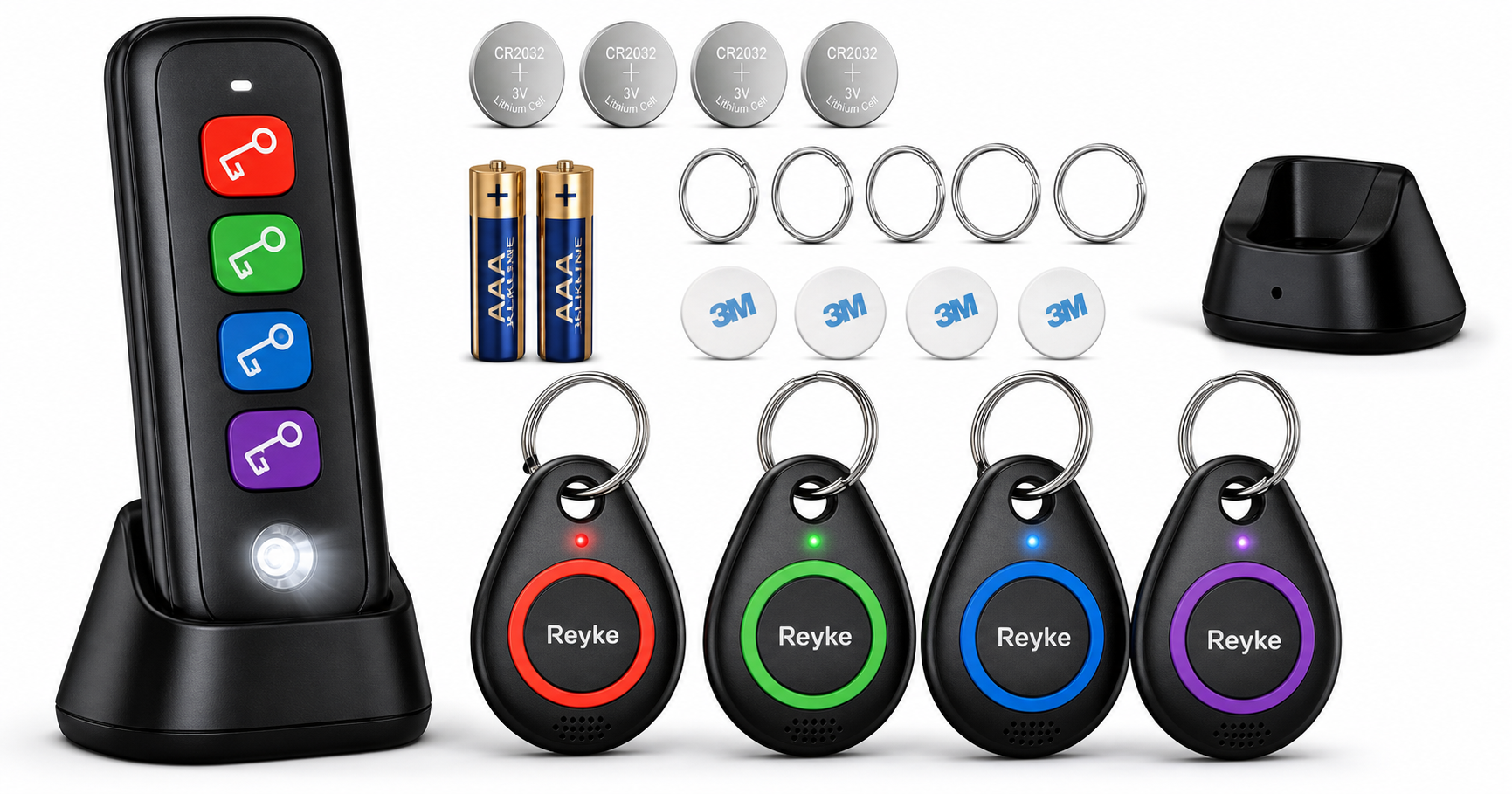
Reyke Key Finder, 80dB+ RF Item Locator Tags (1 Transmitter & 4 Receivers)
Introduction
The Reyke Key Finder is a compact RF-based item locator designed to help you track frequently misplaced belongings such as keys, wallets, TV remotes, phones, glasses cases, and even pet collars. Instead of relying on Bluetooth and a smartphone app, it uses simple radio-frequency (RF) communication between a handheld transmitter and four small, color‑coded receivers.
For households with older adults, children, or anyone who prefers a dedicated remote over a phone app, the Reyke system aims to provide a straightforward, press‑and‑beep way to find lost items around the home. It ships as a complete kit, including batteries for both the transmitter and receivers, so you can get started quickly.
From a value perspective, the Reyke Key Finder typically sits in an affordable price bracket (often around $16.99), competing with other RF key finders and undercutting many Bluetooth trackers when you factor in the four included tags.
Setup / Getting Started
Getting started with the Reyke Key Finder is intentionally simple and does not require pairing to a phone or creating an account.
What’s in the box
A typical Reyke Key Finder kit includes:
- 1 RF transmitter (remote) with color‑coded buttons
- 4 RF receivers (tags), each color‑matched to a button on the transmitter
- 4 x CR2032 coin cell batteries for the receivers
- 2 x AAA batteries for the transmitter
- 4 key rings
- Double‑sided adhesive pads
- A small base or stand for the transmitter (varies by kit revision)
- Basic user manual
Physical design and build
- Transmitter: A slim remote with large, clearly labeled, color‑coded buttons. Each button corresponds to one receiver. There is also a small built‑in LED light that activates with the button press, useful when searching in low light.
- Receivers: Each receiver is a small, lightweight plastic tag with a matching color accent, a metal keyring loop, and a built‑in speaker and LED indicator. They are unobtrusive when attached to keys or slipped into a wallet pocket.
Installation steps
-
Insert the batteries
- Remove the battery covers from the receivers and insert the CR2032 coin cells according to the polarity markings.
- Insert the two AAA batteries into the transmitter.
-
Attach the receivers
- Use the included key rings for items like keys, bags, or pet collars.
- Use the double‑sided adhesive for flat surfaces such as remotes or the back of a wallet or glasses case.
-
Test each channel
- Press a color‑coded button on the transmitter; the matching receiver should emit a loud beep and flash its LED.
- Repeat for all four receivers to confirm everything is working.
No pairing, Wi‑Fi, or app configuration is required. This makes the Reyke Key Finder particularly suitable for users who are not comfortable with smartphone apps or who prefer an offline solution.
Daily Usage
In everyday use, the Reyke Key Finder is designed to be a single‑function tool: locate tagged items quickly.
Locating items
- Press the matching button: When you misplace an item, simply press the color button that corresponds to the receiver attached to it.
- Audible and visual cues: The selected receiver emits an 80dB+ beep and flashes its LED, making it easier to find the item under cushions, in a bag, or in dimly lit areas.
- Range in real scenarios: The advertised working range is up to 131 ft in open space. Indoors, walls, furniture, and doors will reduce this, but in a typical home it’s still effective across multiple rooms and floors for most users.
Use cases
- Keys and wallets: Attach receivers to keyrings or slip them into a wallet compartment. A single button press often narrows down the search to a specific room or drawer.
- TV remotes and small electronics: Adhesive pads make it easy to stick a receiver onto the back of a remote or a streaming box remote.
- Glasses cases: A receiver on a glasses case helps quickly track it down on cluttered desks or nightstands.
- Pet collars: The small size and light weight are well‑suited to cats and small dogs. Pressing the corresponding button helps locate a pet hiding under furniture or in another room. For outdoor tracking, however, the range and RF design are better suited to close‑range locating rather than true GPS‑style tracking.
Usability for different users
- Elderly users: Large buttons, no app, and straightforward operation make this system appropriate for seniors. The transmitter can sit on its base near the front door or on a bedside table.
- Busy families: Assign each family member a color for their main item (e.g., blue for Dad’s keys, red for Mom’s purse, etc.).
- Neurodivergent users or those with ADHD: Having a dedicated, predictable way to trigger a loud alert can be less frustrating than relying on a phone that may be muted or misplaced.
Performance & Reliability
Sound level and audibility
The receivers are rated at 80dB+ at close range, which is loud enough to be heard in a quiet to moderately noisy home. In practice:
- In the same room: The beep is clear and easy to localize.
- Across rooms or behind cushions: The sound is still generally audible but more muffled, especially if the item is buried in fabric or inside a closed drawer.
- Noisy environments: In very loud surroundings (e.g., TV at high volume, parties), you may need to step closer or mute background noise to pick out the beeping.
RF range and penetration
The Reyke Key Finder uses RF signals that can travel through walls and furniture better than many Bluetooth trackers, up to a claimed 131 ft in open space. Indoors, real‑world effective range is typically shorter but still adequate for most apartments and mid‑sized homes.
- Through walls: RF signals usually penetrate one or two interior walls without issue.
- Multi‑story homes: Locating items on another floor generally works, though the audible cue may be softer.
Battery life
The kit includes all required batteries. RF key finders tend to be power‑efficient, especially the receivers, which are idle until triggered.
- Receivers: Coin cell batteries can last many months under normal use (occasional beeping), assuming you don’t trigger them continuously for long periods.
- Transmitter: AAA batteries typically last longer, given that the transmitter is only active when you press a button and briefly power the LED.
Replacing batteries is straightforward but requires opening small battery compartments on the receivers. Users with limited dexterity may need assistance.
Durability
- Build quality: The plastic housings feel light but adequately sturdy for daily use on keyrings or remotes.
- Water resistance: There is no explicit waterproofing. Receivers should be considered splash‑sensitive and kept away from sinks, heavy rain, or pet water bowls. For pet collars, outdoor use should be cautious; the product is best viewed as an indoor locator.
What Works Well
-
No smartphone or app required
Users who dislike installing apps or managing Bluetooth connections will appreciate the completely offline design. -
Simple, intuitive operation
Just press a color‑coded button and follow the sound and flashing light. This ease of use is ideal for children and older adults. -
Four receivers included
The single transmitter controls four tags, allowing you to cover multiple high‑risk items (keys, remote, wallet, pet collar) without buying extra units. -
RF range and wall penetration
RF signals handle walls and furniture relatively well, so the system remains functional even when items are hidden behind obstacles. -
Audible 80dB+ beeper with LED flash
The combination of sound and light makes it easier to pinpoint items that are visually hidden. -
Complete kit with batteries
Bundled CR2032 and AAA batteries mean you can start using the product immediately without extra purchases. -
Cost‑effective per tag
Considering the four receivers and included batteries, the effective cost per tagged item is low at around $16.99 for the whole kit, making it an accessible option for most households.
What Could Be Improved
-
No smartphone integration or map view
The absence of Bluetooth or app support is a design choice, but it means you do not get location history, last‑seen maps, or global tracking. If you routinely lose items outside the home, a GPS or Bluetooth tracker ecosystem may be more appropriate. -
Limited feedback when out of range
If the item is completely out of RF range or batteries are dead in the receiver, the system gives no specific feedback besides silence. A dedicated "out of range" indication would prevent repeated button presses. -
Beep pattern and volume control
The beep is loud but not adjustable. Some users may prefer volume control or multiple tones, both to help distinguish tags by sound and to reduce intensity in quiet environments. -
No water resistance rating
A basic splash‑resistant design or silicone sleeves would increase confidence when using the tags on pet collars or bags that might see occasional moisture. -
Battery replacement on receivers
The small battery doors can be fiddly, especially for users with limited hand strength or vision. Clearer markings or a more tool‑free design would enhance accessibility. -
Bulk on very small items
While compact overall, the receivers may still feel bulky on extremely slim items like minimalist wallets or delicate glasses frames. Placement and adhesive quality matter.
Overall Impression
The Reyke Key Finder, with its 80dB+ RF receivers, up to 131‑foot advertised range, and four included tags, is a strong option for people who frequently misplace items around the home and want a simple, app‑free solution.
It excels in scenarios where:
- Users value simplicity and reliability over smart‑home integrations.
- Households want to equip multiple items with a single, centralized remote.
- Elderly family members or non‑technical users need a straightforward way to locate keys, wallets, or remotes.
On the other hand, if you need out‑of‑home tracking, map‑based location, or deeper integration with your smartphone ecosystem, a Bluetooth tracker or GPS‑based solution may serve you better.
Overall, the Reyke Key Finder offers solid everyday practicality at an accessible cost (around $16.99 for four receivers and a transmitter), making it a sensible choice for households that want to reduce daily "where did I put that?" moments without adding more apps or complexity to their lives.