
REDTIGER F7NP 4K Front and Rear Dash Cam Review: High-Detail Recording with Modern Connectivity
Introduction
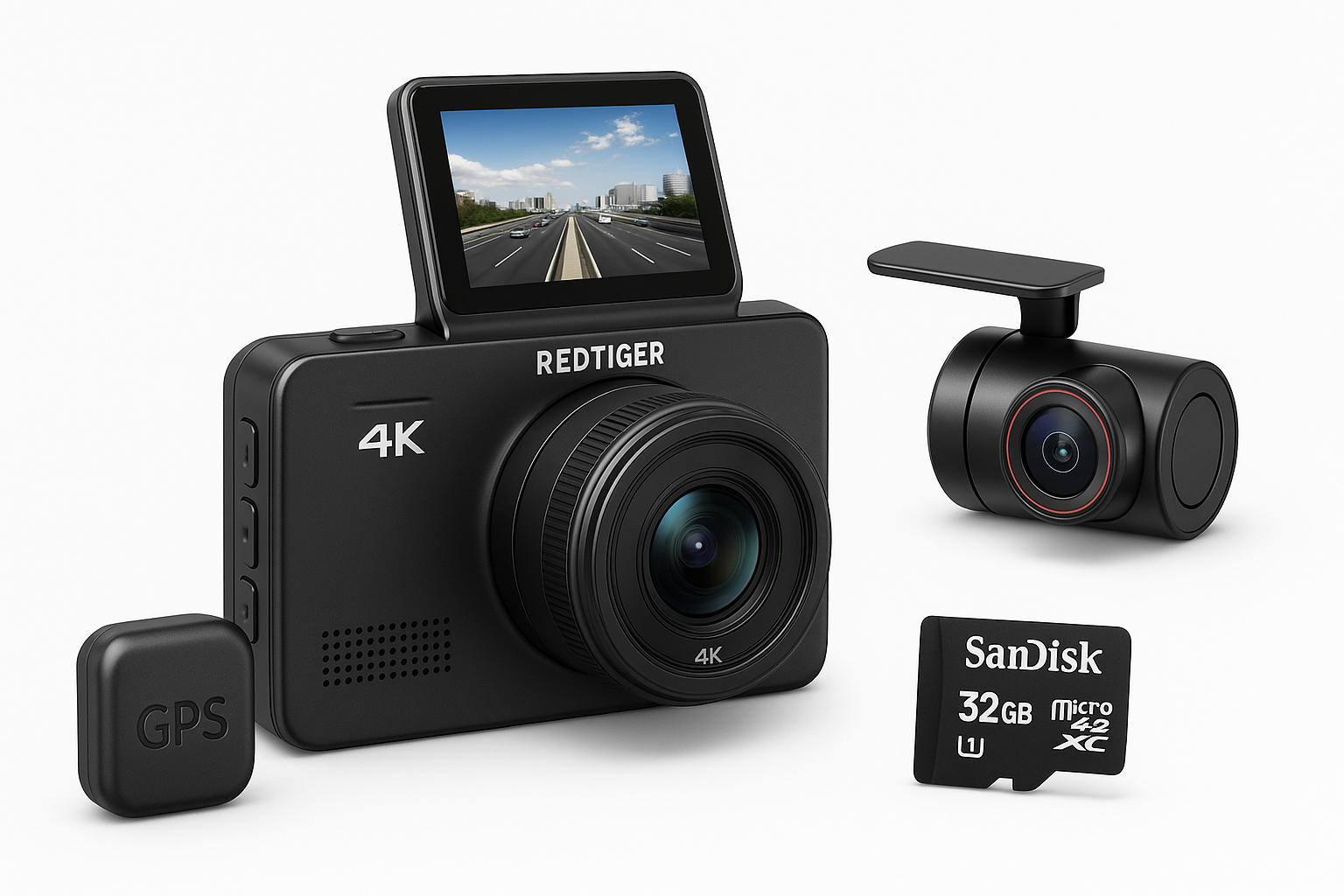
The REDTIGER 4K Dash Cam Front Rear (F7NP) is designed for drivers who want high-detail video coverage of both the front and rear of their vehicle. It pairs a 4K-capable front camera with a rear unit, uses a STARVIS 2 sensor for improved low-light performance, and offers features like GPS tracking, 24-hour parking mode, and 5.8GHz Wi‑Fi for faster smartphone downloads. A memory card is included in the box, which reduces initial setup friction. On paper, this makes the F7NP a strong candidate for anyone looking to upgrade from a basic 1080p dash cam.
In this review, we look at how the REDTIGER F7NP performs in common driving scenarios, what it does particularly well, and where it may fall short depending on your use case. Pricing is competitive for a dual-channel 4K system, with the camera often positioned around $129.99 on its product page.
Typical Use Cases
The REDTIGER 4K Dash Cam F7NP is most suitable for:
-
Daily Commuting in Urban and Suburban Areas
- Capturing routine traffic, close calls at intersections, and lane-change incidents.
- Recording license plates and traffic lights in dense environments.
-
Highway and Long-Distance Road Trips
- Documenting long stretches of highway driving at higher speeds.
- Recording scenic drives in high detail.
- Using GPS data as a driving log for later review.
-
Rideshare and Professional Drivers
- Providing video evidence in case of collisions or disputes.
- Capturing rear-end incidents with the rear camera.
- Quickly downloading clips via 5.8GHz Wi‑Fi to share with insurers or fleet managers.
-
Overnight and Long-Term Parking
- Monitoring for hit‑and‑run accidents or vandalism while parked.
- Utilizing 24-hour parking mode to capture motion or impacts.
-
Drivers in Low-Light or Night-Heavy Conditions
- Commuters who drive before sunrise or after dark.
- Urban drivers where lighting is mixed (streetlights, headlights, signage).
- Users who specifically need better night visibility than a basic sensor can provide.
Performance in Each Scenario
1. Daily Commuting
For everyday city and suburban driving, the F7NP’s 4K front resolution and 170° wide-angle lens provide broad coverage of the road and surrounding lanes. The wide angle helps capture vehicles approaching from the sides, though—as with most wide lenses—objects at the very edges of the frame can appear slightly distorted.
The STARVIS 2 sensor improves dynamic range and clarity in typical commute lighting, handling bright skies, building shadows, and tunnel transitions reasonably well. The built‑in WDR (Wide Dynamic Range) further helps balance bright and dark areas, making key details like brake lights and lane markings more visible.
The rear camera offers solid coverage for tailgating vehicles and rear-end incidents. While it usually records at a lower resolution than the front camera, the detail is generally adequate for understanding events and, in many situations, reading nearby license plates.
2. Highway and Long-Distance Trips
On highways, the 4K front camera provides enough resolution to capture smaller details at speed, such as vehicles several car lengths ahead or road signs you pass quickly. When lighting is good, license plates of nearby vehicles are often readable, especially when they are directly in front.
GPS integration logs speed and location data, which can be useful for verifying how fast you were traveling and where an incident occurred. For users who drive outside their local area regularly, this can be helpful for reviewing specific routes or events later.
The included memory card is convenient, but for frequent long-distance trips, capacity and card endurance should be considered. Continuous 4K recording can quickly use storage, so loop recording settings and clip length should be configured to avoid overwriting key events too soon.
3. Rideshare and Professional Use
Rideshare drivers and professionals benefit from the dual-channel coverage and fast Wi‑Fi transfers. The F7NP uses 5.8GHz Wi‑Fi (up to about 20 MB/s) for faster clip downloads to a compatible smartphone app compared with typical 2.4GHz-only systems.
This is particularly useful when you need to:
- Retrieve a clip immediately after an incident while safely parked.
- Share video with an insurance company or platform support team.
- Review an event between rides without removing the memory card.
The camera’s overall image quality is well-suited for documenting collisions, near-misses, or aggressive driving encounters around the vehicle. However, this model does not appear to be designed to record the interior cabin; drivers who need passenger-facing footage may require a separate interior camera.
4. Parking and Overnight Monitoring
The 24H parking mode is a major feature for users who leave their vehicles in public or shared parking areas. When wired to a constant power source via an appropriate hardwire kit, the dash cam can:
- Monitor for impacts or motion when the car is off.
- Create event-based recordings that are easier to review than continuous footage.
- Provide evidence in case of hit-and-run incidents, break-ins, or vandalism.
The effectiveness of parking mode depends on installation quality and power management settings. Proper configuration helps prevent the camera from draining the car battery significantly, while still ensuring it wakes to record when motion or impacts are detected.
5. Night and Low-Light Performance
The combination of the STARVIS 2 sensor and WDR aims to improve low-light and night performance versus basic sensors. In real-world use, this typically translates to:
- Better visibility of road edges, pedestrians, and obstacles under streetlights.
- More controlled headlight flare from oncoming vehicles.
- Improved clarity in parking lots or residential streets with limited lighting.
While the F7NP’s night footage is stronger than entry-level dash cams, night recording is still inherently challenging: plates at distance or on fast-approaching vehicles may not always be perfectly legible, especially in rain or with heavy glare. Near-field details, however, are generally captured with useful clarity.
Strengths Across Scenarios
-
High-Resolution Front Recording (4K)
The main camera’s 4K capability provides a strong level of detail, particularly beneficial when reviewing incidents frame-by-frame or zooming in on specific regions of the video. -
Dual-Channel Coverage (Front + Rear)
Having both front and rear coverage significantly increases the chance of capturing key details in common scenarios: rear-end collisions, hit-and-runs, or aggressive tailgating. -
STARVIS 2 Sensor and WDR
The sensor and WDR combination helps smooth out difficult lighting, from tunnels and overpasses to nighttime driving in mixed lighting conditions. -
Fast 5.8GHz Wi‑Fi (up to ~20 MB/s)
Faster wireless transfer speeds make it more realistic to pull full‑resolution files directly to a smartphone without relying on a computer or card reader. -
GPS Integration
GPS data provides additional context in incident reports, including speed and route, which many insurers and authorities find useful as supporting information. -
Included Memory Card
The included free card lowers the barrier to first use; you can typically set up and start recording without buying additional storage immediately. -
Wide 170° Field of View
The wide-angle lens captures a broad scene, which is helpful at intersections and multi-lane roads where side activity is often important.
Limitations Across Scenarios
-
Installation Complexity for Full Features
To make full use of 24H parking mode and stable power, a hardwire kit is usually recommended. This adds installation time and may require professional help, especially for users unfamiliar with vehicle electrical systems. -
Storage Management with 4K Recording
4K footage consumes storage quickly. Although loop recording mitigates this, users must ensure the included card capacity is adequate and consider upgrading to a higher-endurance card if they drive heavily. -
Rear Camera Resolution and Detail
While the rear camera is very useful, it usually does not match the front’s 4K detail, so license plate clarity behind the vehicle may be more limited, especially at night or in adverse weather. -
Interior Recording Not Included
Drivers who need in-cabin monitoring (such as some rideshare or taxi operators) will find that this model does not cover the interior by default. A separate solution would be needed for that purpose. -
Wide-Angle Distortion at Frame Edges
The 170° field of view trades some edge distortion for broader coverage. This is common to many dash cams, but users focused on plate clarity at the very edges of the image should be aware of this characteristic. -
Parking Mode Dependent on Power Setup
If the camera is only powered through a cigarette lighter adapter that turns off with the ignition, 24H parking mode will not function as intended. Real benefit requires a constant power source and appropriate low-voltage cutoff settings.
Verdict
The REDTIGER 4K Dash Cam Front Rear (F7NP) is a well-rounded dual-channel system aimed at drivers who prioritize high-detail front recording, useful rear coverage, and modern quality-of-life features like fast Wi‑Fi and GPS logging. Its STARVIS 2 sensor and WDR give it a solid advantage in varied lighting, particularly for users who drive frequently at night or in urban environments with mixed light sources.
With an included memory card and a price typically in the $129.99 range on its product page, the F7NP offers good value for those upgrading from a basic 1080p single-channel camera. Prospective buyers should, however, plan for proper installation—especially if they want to leverage 24-hour parking mode—and consider storage and card endurance if they drive many hours each week.
Overall, the REDTIGER F7NP is a strong option for daily commuters, road-trip enthusiasts, and professional drivers who need reliable front and rear coverage, detailed 4K footage, and convenient wireless access to recordings, without stepping into significantly more expensive multi-camera or fleet systems.