
Dash Cam Front and Rear with 3-Channel Coverage: A Budget-Friendly Triple Camera for Everyday Drivers
Introduction
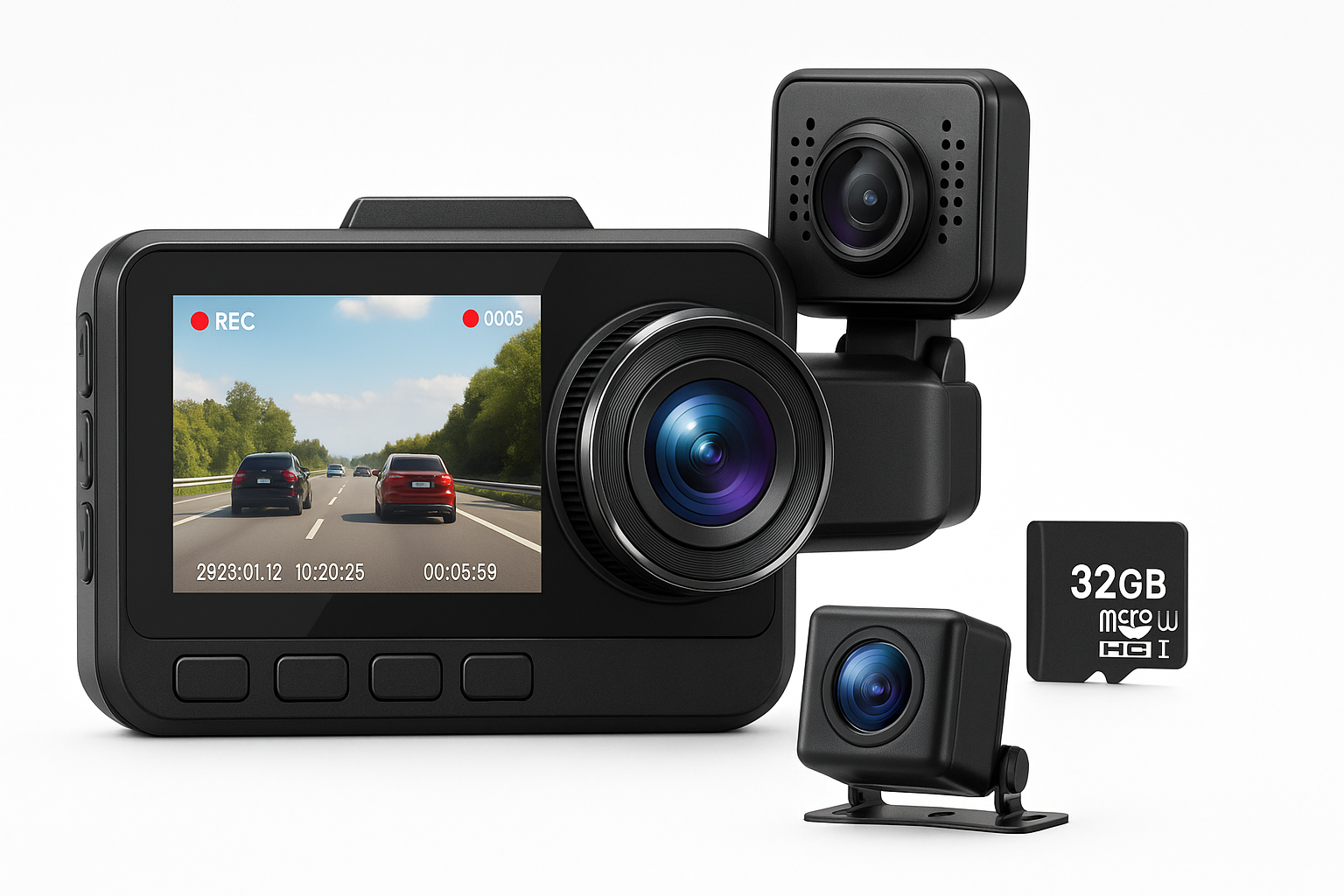
The Dash Cam Front and Rear, 1080P Dash Camera for Cars, 3 Channel Car Camera Front Rear and Inside with 32GB Card, Loop Recording, Night Vision, HDR, 24Hr Parking, G-Sensor targets drivers who want full front, rear, and cabin coverage without a complex setup or extra accessories. With its included 32GB card and triple-camera design, it aims to offer a plug‑and‑play solution for commuters, rideshare drivers, and anyone who wants more evidence and peace of mind on the road.
In this review, we break down the core features, everyday performance, strengths, and limitations to help you decide if this 3‑channel dash cam is the right fit for your car.
Product overview and key features
This dash cam is built around a three‑channel configuration that records simultaneously from:
- A front-facing camera capturing the road ahead.
- A rear camera that typically mounts on the rear windshield to capture traffic behind you.
- An interior/cabin camera designed to record inside the vehicle, useful for rideshare, taxis, or added security.
Key features include:
1080P Full HD recording on all channels
All three lenses record in 1080P Full HD, which is standard for budget 3‑channel systems. While it does not compete with higher‑end 2K or 4K dash cams for plate clarity at long distances, 1080P is generally sufficient for documenting incidents, close‑range license plates, and overall traffic context.
Included 32GB memory card
The dash cam ships with a 32GB card pre‑included, so you can start recording right away without purchasing storage separately. For many users, this is an important convenience and keeps the true cost of the system close to the listed price of $47.98 once you account for the included card.
Note: For heavy daily use, some drivers may eventually prefer upgrading to a higher‑endurance card with larger capacity, but the included card is adequate to get started.
Loop recording
Loop recording automatically overwrites the oldest footage when the card is full. This ensures:
- The camera continues recording without manual file management.
- You always have the most recent driving footage, except for clips that are locked by the G‑sensor or manually protected.
Depending on settings and how many channels are enabled, a 32GB card typically stores a few hours of video before looping, which is acceptable for most commutes and general errands.
G‑sensor and emergency locking
A built‑in G‑sensor detects sudden impacts or strong vibrations. When triggered, it:
- Automatically locks the current video segment, preventing it from being overwritten by loop recording.
- Helps preserve critical evidence around collisions, hard braking events, or hit‑and‑runs.
This is a core safety feature for any dash cam, and it works alongside parking mode for around‑the‑clock protection.
24‑hour parking monitoring
The dash cam supports 24Hr Parking Mode, designed to monitor your vehicle while it is parked. Typical behaviors include:
- Impact‑triggered recording when the G‑sensor detects a bump or attempted break‑in.
- In some configurations, low‑bitrate or time‑lapse recording to conserve card space and power.
To take full advantage of this feature, you usually need a proper power or hardwire solution so the dash cam can draw power while the car is off. This allows it to record short clips when it detects motion or an impact near your parked vehicle.
Night vision and HDR
The camera advertises night vision and HDR (High Dynamic Range) processing to enhance visibility in challenging lighting. In practice, these features are designed to:
- Improve detail in dark scenes such as poorly lit streets and parking lots.
- Reduce glare from headlights and bright streetlights.
- Help balance very bright and very dark areas in the same frame, such as headlights against a dark road.
Compared with basic non‑HDR dash cams, this should provide more usable footage in common night‑time situations, though it still won’t match the low‑light quality of premium dash cams with larger image sensors.
Performance and user experience
Installation and setup
Most users should find installation straightforward:
- Mount the front camera behind the rear‑view mirror using the supplied adhesive mount.
- Route the power cable along the headliner and down the A‑pillar to the 12V socket or hardwire kit.
- Run the rear camera cable from the front unit to the back of the car, tucking it under the headliner and interior trim.
- Position the interior camera (if separate) or adjust the multi‑lens body so that the cabin view is clear.
The inclusion of the 32GB card reduces friction, as you don’t need to worry about compatibility or formatting on first use. Many units auto‑format the card on setup and start recording as soon as they receive power.
Daytime recording quality
During daylight driving, the 1080P resolution on all three channels generally provides:
- Clear lane markings and traffic signs.
- Readable license plates at close to medium distance, especially at lower speeds.
- Sufficient detail to reconstruct traffic events and driver behavior.
On bright days, HDR helps control harsh contrast, for example when exiting tunnels or driving in and out of shade. You can expect some compression artifacts and softening typical of budget 1080P dash cams, but overall the footage should be more than adequate for insurance purposes.
Night‑time and low‑light performance
At night, the dash cam relies on its night vision and HDR to keep footage usable:
- Streetlights and headlights are better managed, so surrounding details stay more visible.
- Interior footage can capture occupants, which is important for rideshare drivers.
- Rear footage remains serviceable for seeing vehicles behind you and capturing close‑range events.
However, as a 1080P budget‑class system, it may struggle to capture perfectly sharp license plates of fast‑moving vehicles in very dark environments. For most users, the trade‑off is acceptable, but drivers who prioritize best‑in‑class low‑light clarity might need to look at higher‑end, more expensive alternatives.
Parking mode behavior
With a suitable power connection, 24‑hour parking monitoring helps in scenarios like:
- Hit‑and‑run incidents in parking lots.
- Door dings or vandalism.
- Suspicious activity around the vehicle.
When the G‑sensor detects a bump while parked, the dash cam wakes and records a short clip, locking it so you can review what happened. Recording length and sensitivity are usually configurable in the menu, allowing you to balance coverage with storage and power usage.
Controls and usability
Although interface details can vary slightly, this style of dash cam typically offers:
- A small built‑in display for live view and menu navigation.
- Physical buttons along the side or bottom for simple control.
- On‑screen icons to indicate recording status, microphone, and lock status.
Once installed, the camera is mostly set‑and‑forget: it powers on with the vehicle, begins recording automatically, and loops footage without user intervention. You only interact with it when you need to:
- Change settings (e.g., resolution, G‑sensor sensitivity, date/time).
- Manually lock a video during an incident.
- Review or export video by removing the card and viewing on a computer.
Pros and cons
Pros
- True 3‑channel coverage: Simultaneous recording from front, rear, and cabin for more complete evidence.
- 1080P resolution on all channels: Adequate detail for daily driving and incident documentation.
- 32GB card included: Ready to use out of the box, no immediate need to buy separate storage.
- Loop recording and G‑sensor: Automatically preserves incident footage while keeping recent video available.
- 24Hr parking mode: Offers extra protection when your car is parked, especially with a suitable power setup.
- Night vision and HDR: Improved visibility and more balanced exposure in low‑light and high‑contrast scenes.
- Generally budget‑friendly 3‑channel option compared with premium brands.
Cons
- 1080P limit: Does not match higher‑resolution 2K/4K dash cams for fine plate detail, especially at night or at highway speeds.
- Storage capacity: 32GB is convenient but can fill quickly when recording three channels at once; frequent loop overwriting is expected.
- Installation complexity: Running cables for both rear and interior channels requires more time and care than a single‑camera setup.
- Power for parking mode: Full 24‑hour monitoring may require a separate hardwire kit and careful configuration to avoid draining the vehicle battery.
- Build and sensor quality: As a budget‑oriented model, materials and imaging performance may not match more expensive, brand‑name dash cams.
Conclusion and recommendation
The Dash Cam Front and Rear, 1080P Dash Camera for Cars, 3 Channel Car Camera Front Rear and Inside with 32GB Card provides an accessible way to step into triple‑channel dash cam coverage without a large upfront investment. With 1080P recording on all lenses, an included 32GB card, loop recording, G‑sensor emergency locking, HDR‑assisted night vision, and 24‑hour parking mode, it delivers a well‑rounded feature set for everyday drivers.
It is best suited for:
- Budget‑conscious drivers who want more than a single front camera and appreciate having rear and cabin views.
- Rideshare and taxi drivers who need interior footage for safety and accountability.
- Owners who park on the street or in public lots and want extra protection while the car is unattended.
You should consider a higher‑end alternative if you:
- Need maximum plate readability at high speeds or in very low light.
- Prefer larger storage or professional‑grade build quality.
- Want advanced features like built‑in Wi‑Fi apps, cloud connectivity, or GPS logging.
Overall, at around $47.98 on its product page, this dash cam offers strong value as a first 3‑channel system and a practical upgrade from basic single‑lens cameras, especially for drivers who prioritize complete coverage and straightforward operation over top‑tier image quality.
For more details or the latest availability, you can refer directly to the product listing:
- Product page: https://www.amazon.com/dp/B0C2Y6WXJ7