
Gskyer 70mm AZ70400 Telescope Review: Entry-Level Travel Scope for Kids and Curious Beginners
What This Product Is
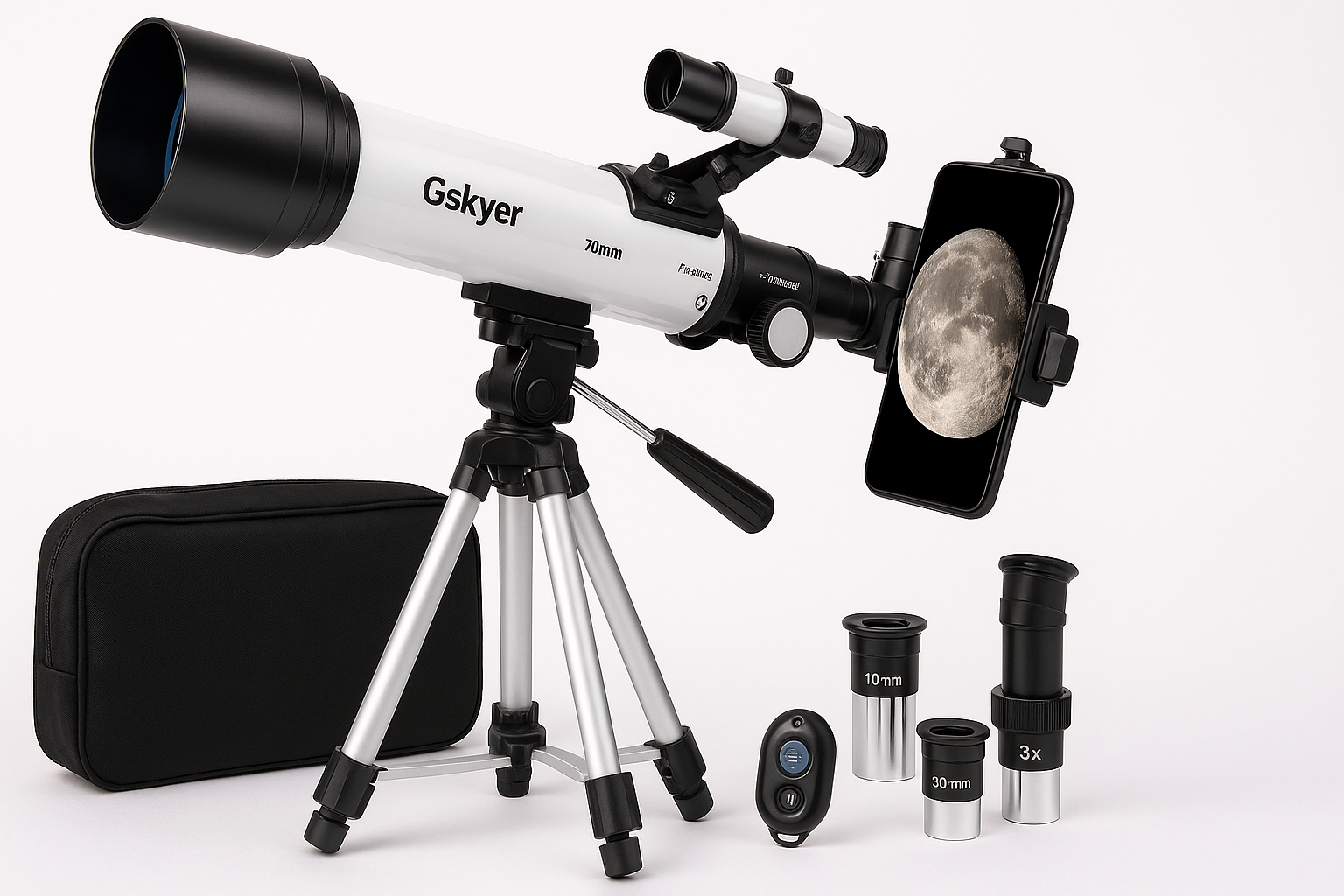
The Gskyer Telescope, 70mm Aperture 400mm AZ Mount Astronomical Refracting Telescope for Kids Beginners is a compact, entry‑level refractor designed primarily for casual backyard and travel use.
Key hardware characteristics:
- Optical design: 70mm achromatic refracting telescope with a 400mm focal length (f/5.7)
- Mount: Lightweight alt‑azimuth (AZ) mount with manual pan/tilt controls
- Optics: Fully coated glass objective advertised for higher light transmission
- Included eyepieces: Typically 25mm and 10mm 1.25" eyepieces for low‑ and medium‑power viewing
- Included Barlow lens: 3x Barlow to boost magnification
- Accessories: 5x24 style finderscope, smartphone adapter, wireless camera shutter remote, diagonal, and a soft carry bag for travel
- Form factor: Roughly 25 inches long assembled, around 5–6 lb including tripod, making it reasonably easy for kids to handle
It is marketed as an all‑in‑one starter kit for observing the Moon, bright planets, and basic terrestrial (daytime) targets, with an emphasis on portability and phone photography.
If purchased on Amazon, it usually sits in the budget beginner bracket around $96.99, positioning it against other sub‑aperture‑80mm starter refractors and small tabletop reflectors.
Why It Matters
For many families and beginners, the first telescope can determine whether astronomy becomes a long‑term hobby or a short‑lived frustration. The Gskyer 70mm attempts to lower the barrier to entry by offering:
- A complete kit in one box (telescope, mount, eyepieces, phone adapter, bag)
- A short learning curve thanks to the simple alt‑az mount
- A kid‑friendly, portable design that can travel to darker skies
In the crowded budget space, this model stands out because it bundles photography‑oriented accessories (phone adapter and remote) that many competitors either omit or sell separately. That makes it appealing to buyers who specifically want to capture quick snapshots of the Moon or share their views on social media, even if the optical system and mount are firmly beginner‑grade.
That said, entry-level refractors of this kind are a compromise: you get low cost and convenience, but you trade away the stability, optical quality, and upgrade path of more serious telescopes. Understanding those trade‑offs is crucial before you commit.
Key Advantages
1. Very Portable, Travel‑Friendly Kit
The combination of a compact 70mm f/5.7 tube, lightweight tripod, and included carry bag makes this telescope genuinely easy to move and store. It fits in a car trunk or closet without taking much space, and most older kids can carry it themselves.
For families who occasionally drive out to darker skies or want to take a telescope on vacation, this is a practical, grab‑and‑go package.
2. Simple Alt‑Az Mount for Beginners
The alt‑azimuth mount lets you move the telescope up/down (altitude) and left/right (azimuth), which is intuitive for children and new users. There is no polar alignment, no counterweights, and no motorization to worry about.
This simplicity helps first‑timers focus on learning how to aim with the finderscope, center a target, and adjust focus, instead of wrestling with equatorial geometry.
3. Complete Accessory Bundle
For the price class, the accessory loadout is generous:
- Two eyepieces (around 16x and 40x without the Barlow) for low and medium magnification
- 3x Barlow lens, which in theory extends your magnification range considerably
- 45° or 90° diagonal (depending on package) for more comfortable viewing
- Phone adapter and wireless remote for basic astrophotography through the eyepiece
- Carry bag that holds the optical tube, tripod, and accessories in one place
For someone who doesn’t want to source extra parts, this “open the box and go” experience is attractive, even if some accessories are better than others in practice.
4. Good First Look at the Moon and Bright Objects
Within the limits of a 70mm aperture and budget optics, this scope can provide:
- Detailed views of lunar craters, maria, and terminator shadows
- Recognizable views of Jupiter’s bright moons and basic disk
- A small but distinct Saturn with its ring system visible as an ellipse
- Bright targets like Venus phases, large open clusters, and some brighter double stars
Under decent conditions, these views can be impressive to children and newcomers seeing them for the first time.
5. Budget‑Friendly Entry Point
With a street price around $96.99 on Amazon, the Gskyer 70mm keeps initial investment low. For parents who are unsure whether a child’s interest in astronomy will stick, or for casual observers on a tight budget, this makes the decision less risky.
Key Limitations
1. Mount and Tripod Stability
One of the most commonly reported pain points with this class of telescope is its wobbly, lightweight tripod and basic mount.
Issues that often come up:
- Noticeable vibration when focusing or bumping the tripod
- Difficulty making precise, fine movements, especially at higher magnification
- Plastic controls that can flex or feel imprecise
For lunar viewing at low power, this is manageable; for higher magnification on planets, it can be frustrating and makes tracking targets across the sky more challenging, especially for children.
2. Optical and Accessory Quality Are Strictly Entry‑Level
While the main 70mm objective can provide pleasing views at modest power, the included eyepieces and 3x Barlow are budget components. In practice, this can lead to:
- Softness or chromatic aberration (color fringing) on bright objects
- Reduced contrast compared to higher‑quality eyepieces
- The 3x Barlow often pushing magnification beyond what the optics and atmosphere can support, resulting in a larger but blurrier image
Many experienced observers recommend using the telescope’s lower magnification options and potentially upgrading to a higher‑quality eyepiece later rather than relying heavily on the bundled Barlow.
3. Limited Deep‑Sky Performance
A 70mm aperture simply does not gather enough light for serious deep‑sky observing. Under dark skies you can see:
- Some bright star clusters
- A faint Orion Nebula and similar showpiece objects
But galaxies, planetary nebulae, and fainter clusters will be challenging or invisible. If your main interest is deep‑sky observing, this telescope will feel underpowered.
4. Learning Curve with the Finder and Alignment
Beginners commonly report confusion when trying to get the telescope pointed correctly. Typical challenges include:
- Aligning the finderscope with the main scope before observing
- Understanding that what you see in the finder must be centered precisely before checking the main eyepiece
The manual and some online guides help, but there is still a learning curve—especially for younger kids using the telescope without adult guidance.
5. Not a Long‑Term Platform for Serious Astronomy
This is not a mount or optical system that you can meaningfully upgrade into a serious astrophotography rig or an advanced visual setup. You can improve the experience with better eyepieces, but the basic tripod and mount will remain the limiting factor.
For users who quickly outgrow beginner equipment, this scope may feel like a short‑term step rather than a long‑term investment.
Who It’s For
The Gskyer 70mm AZ70400 makes the most sense for:
- Families with kids who want a first look at the Moon and bright planets without a big upfront cost
- Casual observers who are astronomy‑curious and mainly want occasional backyard or vacation use
- Gift buyers seeking a complete, good‑looking starter kit that doesn’t require additional purchases out of the box
- Beginners who value portability and need a telescope that stores easily in small spaces
- Social‑media‑minded users who primarily want a way to take quick phone snapshots through the eyepiece rather than chase the best possible optical performance
If expectations are set correctly—that this is a basic, introductory telescope—many users in these groups can have fun and learn the sky with it.
Who Should Skip It
You should consider skipping this model and looking at more robust alternatives if:
- You want serious, long‑term astronomy performance. If you already know you’re committed to the hobby, a higher‑quality refractor or a small Dobsonian reflector will provide more stable mounts, cleaner optics, and a clearer upgrade path.
- You are sensitive to mount wobble and focusing shake. If small vibrations will bother you, or you plan to use higher magnifications on planets frequently, you’ll likely find the tripod limiting.
- Deep‑sky observing is your main goal. For nebulae, galaxies, and fainter clusters, larger aperture (e.g., 114–130mm reflectors or 90mm+ refractors) is a better starting point.
- You intend to pursue true astrophotography. While the phone adapter is fun, this setup is not designed for long‑exposure imaging or tracking; a sturdier equatorial or computerized mount would be more appropriate.
In these scenarios, it may be worth bypassing this scope and saving for a more capable entry‑ to mid‑level instrument.
Final Recommendation
The Gskyer 70mm Aperture 400mm AZ Mount Astronomical Refracting Telescope for Kids Beginners is best viewed as a starter, kid‑oriented travel scope. It offers a genuinely portable form factor, intuitive operation, and a generous bundle of accessories—including a phone adapter and carry bag—at an accessible price point around $96.99.
Its strengths are convenience, ease of storage and transport, and the ability to deliver engaging first views of the Moon and bright planets. Its weaknesses—chiefly the lightweight mount, basic accessories, and limited aperture—mean it is not ideal for demanding users, high‑power planetary work, or deep‑sky observing.
If you are buying for a child, a family member who is just curious, or you want a low‑commitment way to test the waters of amateur astronomy, this telescope can serve as a fun introduction—provided you keep your expectations realistic and stick to its strengths. Ambitious beginners or those already serious about the hobby, however, will be better served by investing in a more robust, higher‑aperture system from the outset.