
Elikliv EDM4 4.3-Inch LCD Digital Coin Microscope Review: Compact Viewing for Coins and Close-Up Work
Overview
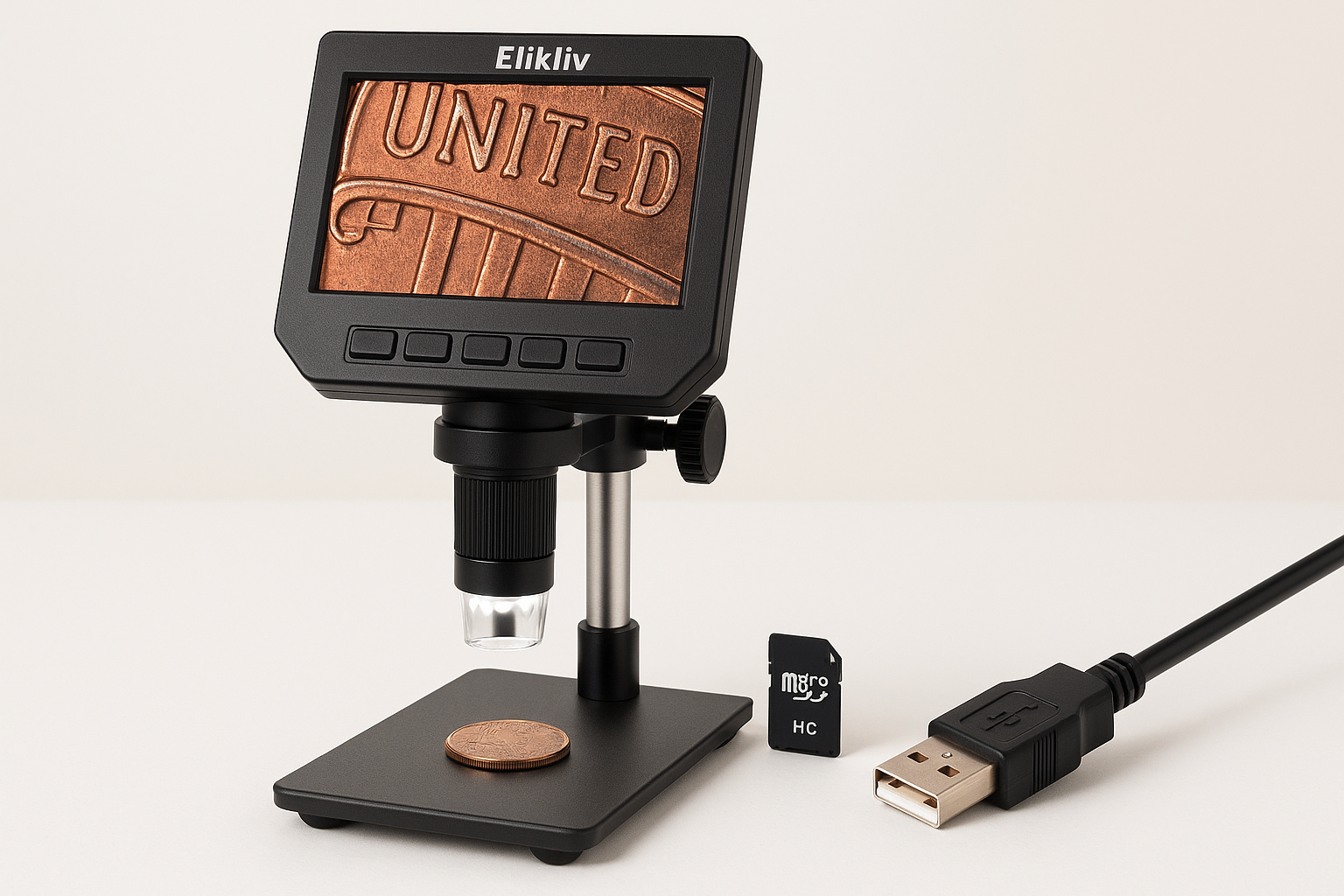
The Elikliv Microscope, LCD Digital Coin Microscope 1000x (EDM4, 4.3‑Inch) is a small, self-contained digital microscope built around a 4.3‑inch color LCD. It targets coin collectors, hobbyists, and light electronics work, offering enough detail to inspect coin errors, surface wear, stamps, circuit boards, and other small objects without the complexity of a traditional optical microscope.
Instead of an eyepiece, the EDM4 uses a camera sensor feeding directly to its LCD screen. A ring of 8 adjustable LED lights provides illumination, and the unit can also connect to a computer via USB for a larger viewing area or capture and storage of images and video. For buyers in its budget segment (around $33.24 on Amazon), it aims to provide an accessible, ergonomic alternative to simple loupes or bare USB microscopes.
Standout Features
4.3‑Inch Integrated LCD Display
The defining feature of the Elikliv EDM4 is its 4.3‑inch LCD screen. This eliminates the need to squint through an eyepiece or rely solely on a connected PC for viewing. The on-board display is large enough to comfortably frame a coin or small component while still keeping the microscope compact on a desk.
- 720p/HD-class digital imaging delivers clear, usable images for identifying scratches, doubling, and other surface features.
- The screen angle and height are fixed by the stand, but the size is sufficient for a quick visual scan before deciding if you need to switch to a larger monitor via PC.
Up to 1000x (Digital) Magnification
Elikliv lists the microscope at 50–1000x magnification. In practice, like most budget digital microscopes, this figure is a combination of optical and digital zoom plus screen enlargement. It is still more than adequate for the intended uses:
- Close examination of coins, stamps, jewelry, printed circuits, and small parts.
- Inspecting print quality and surface textures on materials.
The actual useful magnification is typically in the mid range where sharpness and field of view stay balanced, but having the higher digital zoom is helpful for quickly checking suspected micro-details without changing hardware.
Adjustable Illumination with 8 LEDs
Good lighting is crucial for any digital microscope. The EDM4 integrates 8 adjustable LED lights around the lens, providing direct, even illumination.
- Brightness can be tuned via the on-device controls to reduce glare on shiny metals like coins.
- The LED arrangement helps highlight fine scratches, relief, and raised lettering.
While it lacks more advanced lighting options (like side lights or backlighting for true transmitted-light microscopy), the built-in LEDs are well suited for reflective objects and surface inspection.
PC Connectivity (Windows and Mac)
A key advantage over basic USB-only microscopes is that the EDM4 can be used either as a standalone viewer or connected to a computer.
- USB 2.0 (micro USB interface) connects to Windows PCs.
- Many versions of the EDM4 series are also compatible with MacBook/macOS, allowing live viewing and capture on a larger screen when paired with suitable software.
This dual-mode design means you can use the LCD for quick inspection at the desk, then move to PC when you need finer control, larger images, or easier saving and sharing of photos.
Supporting Features
Beyond the primary display, magnification, lighting, and PC connectivity, the EDM4 offers several secondary features that enhance its functionality:
- Photo and video capture to microSD card (up to 32 GB, card support varies by bundle), so you can document coin varieties or create before/after records of small repairs.
- On-board menus and controls for adjusting magnification (digital zoom), brightness, image settings, and capture modes without needing a PC.
- Rechargeable power (via built-in battery in most packages), making the unit reasonably portable on a workbench or tabletop.
- Compact stand and metal/plastic build, balancing stability with a small footprint.
These features make the EDM4 flexible enough for hobbyist documentation and light educational use while still keeping the interface straightforward.
Usability
Setup and First Use
Getting started with the Elikliv EDM4 is generally simple:
- Assemble the stand and mount the microscope body.
- Power it on and adjust the focus by moving the lens relative to the subject.
- Use the on-device buttons to control zoom, brightness, and capture.
The included stand allows vertical adjustment to accommodate different object heights. For full-coin views, you’ll typically raise the lens as high as the post allows, then fine-tune focus.
Ergonomics
Compared to handheld loupes or tiny USB-only microscopes, the 4.3‑inch screen significantly improves comfort:
- No need to hunch directly over the workpiece—you can sit back and watch the LCD.
- The physical controls are reachable with one hand, though the small buttons can feel cramped for larger fingers.
The compact base keeps the unit easy to store, but this also means the stand column is not as tall as on premium microscopes. For some large coins or taller objects, you may find the working distance limited, and you might need to adjust object position to keep it within the field of view.
Software and PC Experience
When connected to a PC via USB, the EDM4 behaves largely like a standard USB camera:
- On Windows, common webcam or microscope software can be used to view, focus, and capture stills or video.
- On Mac, compatibility depends on available camera apps, but many users can access it through native or third-party tools.
The PC integration is not complex or feature-heavy, but it does the job: larger display, easier saving, and optional annotation using external software.
Performance
Image Quality
For its class, the EDM4 delivers solid image quality:
- At moderate magnifications, coins and small objects appear sharp and detailed, with clear separation between ridges, letters, and relief.
- The built-in LEDs provide uniform front lighting, though very reflective surfaces may still show hotspots.
- Color accuracy is acceptable for hobby work, although it is not calibrated for professional imaging.
At the highest claimed magnifications, the image quality naturally softens, as much of the zoom is digital. Still, for identifying minor dings, contact marks, or die chips on coins, the level of detail is typically sufficient.
Focus and Working Distance
Focusing is done manually by adjusting the distance between the lens and the subject:
- The focus range is adequate for normal coins, small PCBs, and similar items.
- Users should expect a relatively shallow depth of field at higher magnifications—common to all digital microscopes—requiring small adjustments when moving around a specimen.
For more demanding inspection tasks (e.g., larger electronics assemblies or thick objects), you may find the stand height a limiting factor. For flat, small items, however, it performs well within its design constraints.
Stability and Build
The combination of a metal stand components and plastic housing results in a device that feels reasonably sturdy for the price range:
- The base provides enough weight to keep the microscope from wobbling during normal use.
- Adjustments can introduce minor vibrations but they typically settle quickly for clear images.
This is not a lab-grade instrument, but for hobbyists and collectors, the construction is appropriate.
Pros and Cons
Pros
- All-in-one design with 4.3‑inch LCD—no separate monitor required.
- Up to 1000x digital magnification suitable for coins, stamps, and small electronics.
- 8 adjustable LED lights provide practical, front-facing illumination.
- PC connectivity (Windows/Mac) for larger display and easier image capture.
- MicroSD support (up to 32 GB in many bundles) for standalone photo and video recording.
- Compact footprint fits easily on desks, hobby benches, and small work areas.
- Typically offered at a budget-friendly price point (around $33.24), making it accessible for beginners.
Cons
- The highest magnification is largely digital, so ultra-close images may lack the crispness of higher-end optical microscopes.
- Stand height and working distance can be limiting for very large or tall objects.
- On-board controls are functional but somewhat small and basic.
- Image quality and software experience, while adequate, do not match more expensive laboratory or professional inspection scopes.
- Requires a bit of trial and error to balance LED brightness on highly reflective surfaces like polished coins.
Summary
The Elikliv EDM4 4.3‑Inch LCD Digital Coin Microscope is a pragmatic solution for hobbyists, coin collectors, and tinkerers who want detailed close-up views without the cost or complexity of a lab microscope. Its integrated LCD, adjustable LED lighting, and optional PC connection provide a versatile platform for examining coins, stamps, small components, and more.
If your primary goals are:
- Inspecting coins for errors, wear, or varieties,
- Taking quick, shareable pictures of small objects,
- Or performing light inspection work on electronics and crafts,
this microscope delivers good value at its typical asking price of around $33.24. Users who need exceptionally high optical quality, a taller stand, or more advanced illumination modes may want to consider higher-end digital or optical scopes, but for entry-level and intermediate hobby use, the Elikliv EDM4 offers a well-balanced mix of features, performance, and affordability.