
20x50 High Powered Binoculars for Adults: Long‑Range Viewing on a Budget
Overview
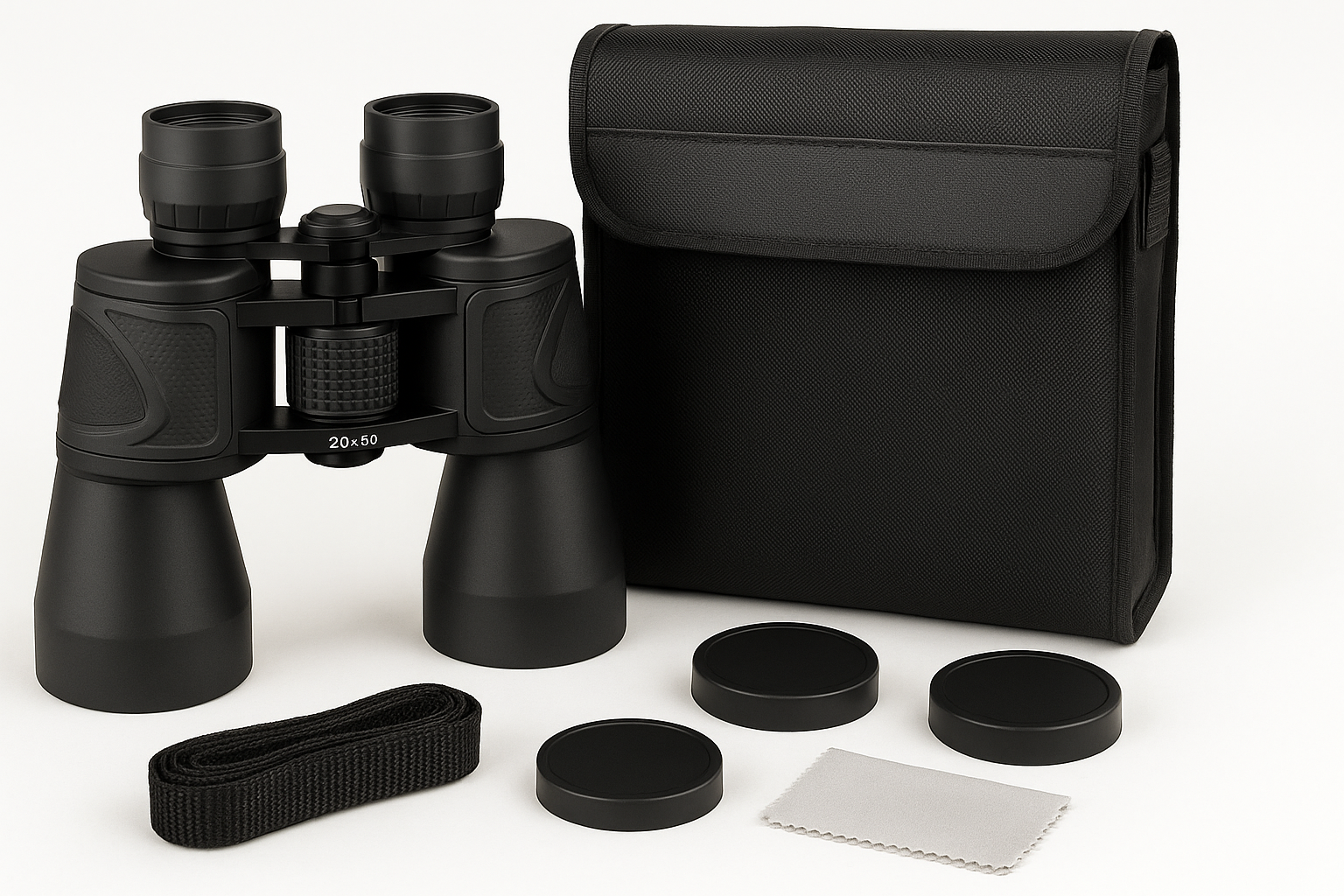
The 20x50 High Powered Binoculars for Adults (B0CJRTRRTG) are a budget‑friendly, long‑range viewing option aimed at users who want more magnification than typical 8x or 10x binoculars. With 20x power and 50 mm objective lenses, these binoculars promise detailed views of distant subjects—whether that’s birds across a lake, players on a field, or bright celestial objects in the night sky.
The design combines:
- A 20x fixed magnification for long‑distance viewing
- 50 mm objective lenses for better light gathering
- Multilayer‑coated optics and Porro prisms for improved brightness and contrast (fumba.store)
- A rubber‑armored waterproof housing intended for outdoor use in mixed conditions (fumba.store)
These specifications place the binoculars in the “entry‑level high power” segment: more reach than standard hiking or stadium binoculars, but still relatively compact and hand‑holdable for short sessions.
Key Highlights
- High 20x magnification for long‑range detail on birds, wildlife, ships, or distant landscapes.
- Large 50 mm objective lenses to gather more light than compact models and support low‑light viewing at dawn, dusk, or under bright moonlight. (fumba.store)
- Multilayer‑coated aspherical lenses and BAK‑4 Porro prisms (per the product documentation) to enhance sharpness, contrast, and edge‑to‑edge clarity. (fumba.store)
- Waterproof, rubber‑armored exterior, providing basic protection against rain, splashes, and bumps.
- Low‑light vision capability (not true night vision) to maintain usable brightness when light levels drop, as long as there’s still ambient light.
- Tripod interface for more stable long‑range or stargazing sessions.
- Marketed as a multi‑purpose tool for bird watching, hunting, camping, travel, cruises, hiking, sports, and stargazing.
Core Features
Optical System
- Magnification & objectives: 20x50 configuration (20x magnification, 50 mm objective lenses). This allows you to resolve smaller details at long range than 8x or 10x alternatives, though at the cost of a narrower field of view and more visible hand shake.
- Prism type: Porro‑prism layout, which usually delivers a pleasant sense of depth and good light transmission at this price point.
- Coatings: Multilayer‑coated aspherical lens elements are specified, aimed at reducing reflections and improving image brightness and contrast. (fumba.store)
- Low‑light performance: The 50 mm objectives give the binoculars decent light‑gathering ability. Combined with the coatings, they should remain usable in dim conditions—sunset wildlife viewing or city‑light‑aided stargazing—though they are not optimized for extreme darkness.
Build & Ergonomics
- Chassis & armor: Rubber‑armored housing designed to improve grip and offer basic impact resistance. The overall form factor is relatively compact for a 20x50 binocular but still larger and heavier than typical compact travel binoculars. (fumba.store)
- Waterproofing: Marketed as waterproof, making them suitable for use in light rain, mist, and damp environments often encountered on hikes, hunting trips, or boat decks.
- Focusing: Central focus wheel plus a right‑eye diopter adjustment to compensate for eye‑to‑eye differences, a standard arrangement in this category. (manuals.plus)
- Eyecups: Twist‑up eyecups are typical for this style, allowing both eyeglass wearers and non‑wearers to adjust eye relief.
- Tripod interface: A built‑in tripod adapter socket (reported in the manual imagery) enables mounting to a standard tripod or monopod, which is strongly recommended for extended viewing at 20x. (manuals.plus)
Included Accessories
While exact accessories can vary by seller, typical bundles for this specific model and nearly identical SKUs include:
- Carrying case
- Neck strap
- Objective and eyepiece lens caps
- Cleaning cloth
These basics help protect the optics and make the binoculars easier to transport. (walmart.com)
Usage Experience
Handling & Stability
At 20x magnification, hand stability becomes a real factor. Even modest tremor or body movement is magnified, which can make the image appear shaky when held freehand. Experienced users note that 10x is about the upper limit for comfortable hand‑held viewing; 20x is more demanding and ideally tripod‑mounted for the steadiest image. (reddit.com)
In practice:
- Short, casual looks (e.g., quick views of a distant bird or landmark) are feasible hand‑held, especially if you brace your elbows or lean against a support.
- Extended viewing (e.g., scanning a field for wildlife, following sports action, or detailed astronomy) benefits greatly from a tripod or at least a monopod.
The body size is moderate for a 20x50 Porro, so most adults should be able to get a comfortable two‑handed grip. Rubber armor helps, especially in wet or cold conditions.
Optical Impressions
For its category and price, this 20x50 model should deliver:
- Good center sharpness suitable for recognizing details like bird markings or jersey numbers at distance.
- Noticeable edge softness compared with higher‑end optics, which is typical in this budget segment.
- Reasonable brightness in daylight and early twilight, though at night the 20x50 configuration’s small exit pupil (around 2.5 mm) limits how bright the view feels compared to something like a 10x50. (bhphotovideo.com)
Chromatic aberration (color fringing) and glare may be more noticeable against very bright backgrounds or high‑contrast edges, again reflecting the trade‑offs at this price level.
Low‑Light and Night Use
The marketing highlights “low light vision,” which in context means enhanced low‑light usability, not electronic night vision or IR amplification.
- In dusk or dawn conditions, the generous 50 mm objectives help keep the image reasonably bright.
- Under urban skies or bright moonlight, the binoculars are capable of enjoyable views of the Moon, bright star clusters, and cityscapes, particularly when mounted on a tripod.
- In very dark rural skies, the limited exit pupil and budget‑class coatings will make them less effective than lower‑magnification 10x50 binoculars designed for astronomy. (reddit.com)
Everyday Field Use
For bird watching, hunting, sports, and general travel sightseeing:
- The long reach is helpful when subjects are far away and you need extra detail.
- The narrower field of view and higher shake make them less ideal for close, fast‑moving subjects (e.g., small birds in nearby trees) than 8x or 10x models.
Users who primarily observe static or slow‑moving targets at long distances will get the most out of this configuration.
Strengths
-
High Reach for the Money
The 20x magnification and 50 mm objectives provide substantial long‑range capability at a price point that is usually much lower than premium optics with similar specs. -
Versatile Outdoor Design
Waterproofing, rubber armor, and included covers/case make the binoculars suitable for use in variable outdoor conditions, from coastal lookouts to damp forests. (fumba.store) -
Improved Brightness vs. Small Compacts
Compared to tiny 8x21 or 10x25 pocket binoculars, the 50 mm objectives gather significantly more light, improving low‑light usability and overall image comfort. -
Tripod Compatibility
The tripod interface transforms them into a stable long‑range viewer or casual astronomical instrument when paired with even a basic camera tripod. (manuals.plus) -
Multi‑Purpose Positioning
One pair can cover a wide variety of casual activities: bird watching at a distance, spotting game across open fields, watching ships or whales from shore, viewing sports from the stands, and sampling the night sky. -
Gift‑Friendly Packaging and Use Cases
Marketed explicitly as suitable for Christmas or birthday gifts for men, the feature set and general‑purpose utility make it an accessible gift choice for someone new to optics.
Weaknesses
-
High Magnification Is Hard to Hold Steady
At 20x, many users will struggle with image shake when hand‑holding. A support (tree, railing, or tripod) is strongly recommended for comfortable long sessions. (reddit.com) -
Narrower Field of View
Relative to 8x or 10x binoculars, the apparent field is typically narrower, making it slower to acquire moving subjects and less immersive for wide vistas. -
Small Exit Pupil for Night Work
The 20x50 format yields a small exit pupil, which can make the image dimmer and less forgiving at night compared to 10x50s or 7x50s that are traditional favorites for astronomy and marine use. (bhphotovideo.com) -
Budget‑Segment Limitations
As an affordable product, it will not match the optical refinement, build precision, or long‑term durability of mid‑range or premium binoculars from major optics brands. -
Not True Night‑Vision
The “low light vision” wording might mislead some buyers expecting electronic night‑vision capabilities; this model relies purely on optical light gathering and coatings.
Suitable Scenarios
These 20x50 binoculars are particularly well‑suited to:
- Long‑distance bird watching and wildlife observation where subjects are hundreds of yards away, such as raptors on distant trees or waterfowl across a lake.
- Hunting and scouting in open country, where you glass across valleys, fields, or ridgelines to locate game.
- Travel, cruise, and coastal viewing, including spotting landmarks, ships, or wildlife from decks, shorelines, or viewpoints—ideally using a rail or tripod for stability.
- Sports events in large stadiums, where you sit far from the action but want to read numbers and see facial expressions.
- Casual stargazing, especially of the Moon, planets, and bright clusters, when mounted on a tripod.
They are less optimal when:
- You mainly watch fast, close birds in dense foliage; a lighter 8x or 10x binocular will be more responsive.
- You need extended hand‑held use with minimal fatigue and shake.
- You prioritize premium image quality and long‑term ruggedness over price.
Final Evaluation
The 20x50 High Powered Binoculars for Adults (B0CJRTRRTG) offer an appealing combination of high magnification, large objective lenses, waterproof construction, and tripod compatibility at an accessible cost of around $35.98 on the product page.
They are best viewed as a value‑oriented, long‑range specialist: very capable for distant, relatively static subjects and occasional astronomy, provided you stabilize them adequately. Users who understand the trade‑offs of 20x power—more shake, narrower field, smaller exit pupil—will likely find them a useful tool for specific tasks.
If you are looking for one affordable pair of binoculars primarily for long‑distance viewing on trips, at the range, or from home, and are willing to use a tripod or solid support when needed, this model is a reasonable option. If you want a more general‑purpose, always‑hand‑held solution for birding or hiking, a lower‑magnification 8x42 or 10x50 binocular may serve you better.